
If you are scoping a battery energy storage project for a factory, warehouse, or commercial site in 2026, the two questions are always the same: how much does it actually cost, and how long until it pays back. This guide gives you a working number for commercial and industrial BESS cost per kWh, the factors that move it, and a realistic ROI model you can adapt to your own load profile — without the vendor spin.
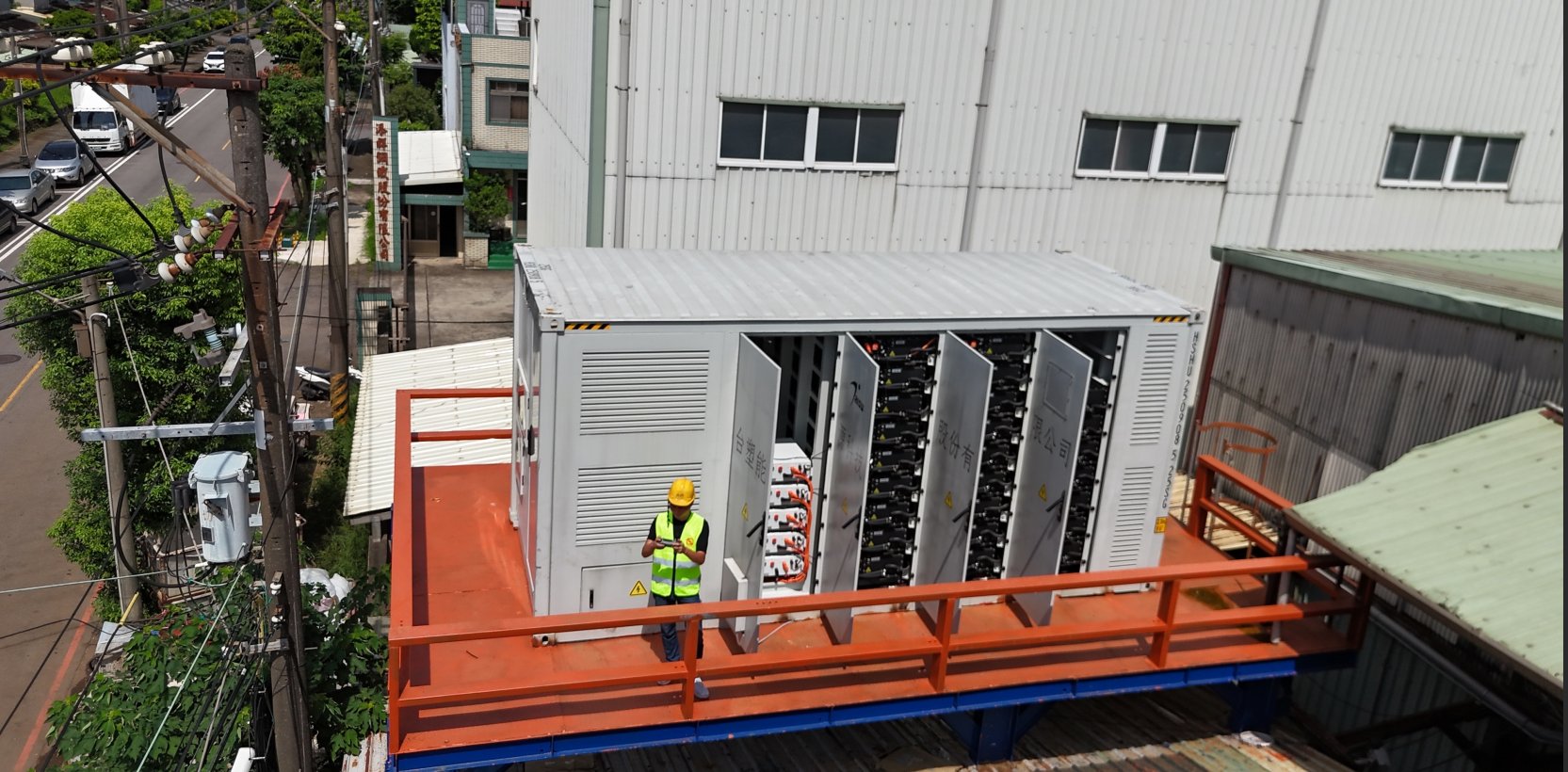
Image 1 — A TAOYAN container ESS deployed at a commercial site in Taiwan, China.
What Is a Commercial & Industrial BESS?
A commercial and industrial battery energy storage system (C&I BESS) is a fixed, site-level lithium battery installation that stores grid or solar electricity and discharges it on demand to cut energy cost, improve power quality, or provide backup. Unlike a residential battery, a C&I system is sized in the hundreds of kWh to multiple MWh and is almost always paired with an energy management system (EMS) that decides when to charge and discharge.
C&I BESS = a stationary lithium-ion (typically LFP) storage system from ~100 kWh to several MWh, installed at a commercial or industrial facility, controlled by an EMS for peak shaving, demand charge management, solar self-consumption, or backup.
The three hardware layers are identical across vendors: the battery modules (LFP cells), the power conversion system / PCS (the inverter that converts DC↔AC), and the EMS + thermal management that keeps it safe and profitable.
2026 Commercial & Industrial BESS Cost per kWh
System price depends mainly on scale: bigger systems have a lower $/kWh because the PCS, EMS, and engineering are spread over more capacity. Indicative 2026 turnkey pricing for LFP systems (equipment + balance-of-system + commissioning, excluding major grid-connection upgrades):
| System size | Typical turnkey cost | $/kWh (approx.) |
|---|---|---|
| 100–300 kWh (cabinet) | $40k–$110k | $380–$480 |
| 500 kWh–1 MWh | $200k–$420k | $330–$420 |
| 1–5 MWh (container) | $400k–$1.8M | $280–$380 |
| 5 MWh+ (multi-container) | $1.8M+ | $240–$320 |
These are indicative ranges, not quotes. Cell prices, local labor, and grid-interconnection scope swing the final number materially. TAOYAN quotes are project-specific.
Two things to read from the table: (1) cost per kWh falls sharply as you cross from cabinet to container scale, and (2) the “equipment only” figure you see in headlines is typically 60–70% of true turnkey cost — the rest is PCS, EMS, thermal system, civil works, and commissioning.
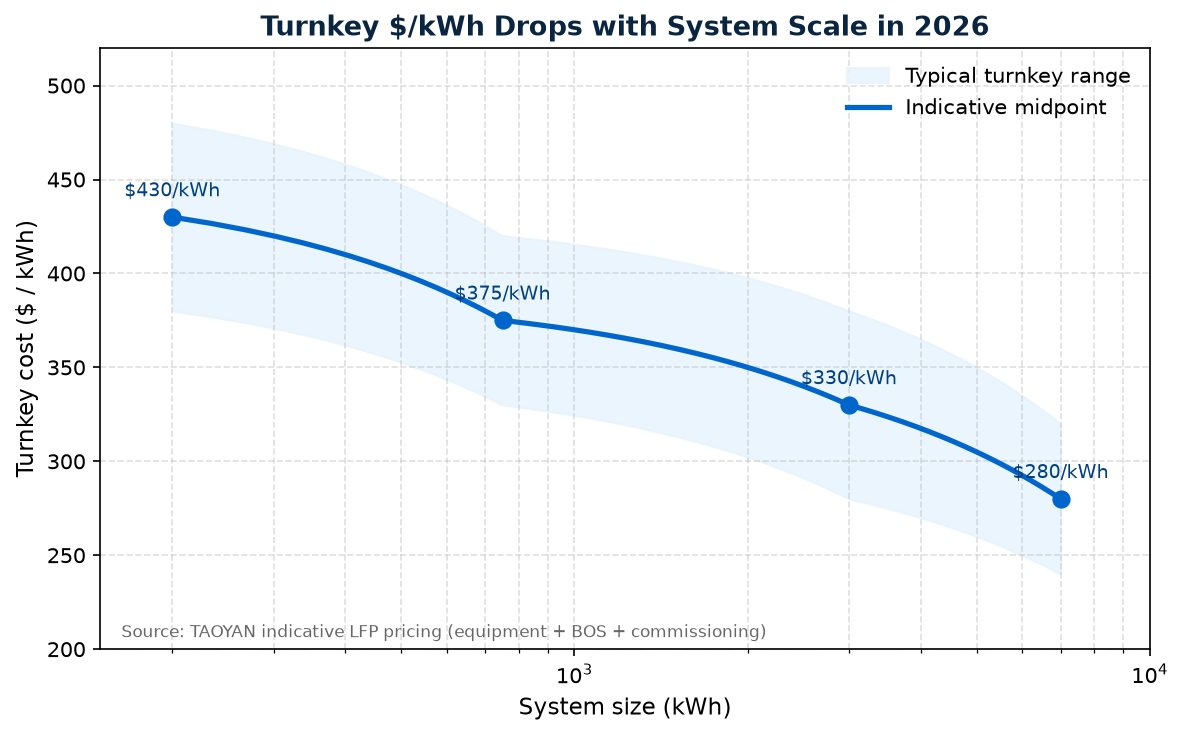
Image 2 — Turnkey $/kWh vs system size. The shaded band shows the typical range; the line is the indicative midpoint.
What Actually Drives the Price
Six line items move commercial and industrial BESS cost more than anything else:
- Cell chemistry & grade — LFP (LiFePO₄) dominates C&I in 2026 for safety and cycle life (6,000+ cycles). Grade-A LFP costs more upfront but is cheaper per cycle.
- PCS / inverter power — A 0.5C system (2-hour discharge) needs half the inverter power of a 1C system, so a longer-duration system is often cheaper per kWh of energy but you pay for power separately.
- Cooling method — Air-cooled is cheaper and simpler; liquid-cooled packs run tighter temperature windows, extend cell life, and suit high-density containers.
- EMS intelligence — Rule-based EMS is cheap; AI/forecast-driven EMS that optimizes against live tariffs recovers its cost through better arbitrage.
- Installation & civil works — Pad, conduit, fire suppression, and permitting vary wildly by region.
- Warranty & service — 10-year / 6,000-cycle warranties cost more than bare equipment but de-risk the ROI.
ROI and Payback: A Worked Example
The fastest payback for most C&I sites is peak shaving — discharge during the few expensive hours of the day so you never touch the peak demand tier.
Assumption (illustrative): a 1 MWh / 500 kW system, turnkey cost $380,000, used 300 cycles/year for peak shaving, saving $0.18/kWh across 900 kWh of daily peak displacement.
- Daily saving ≈ 900 kWh × $0.18 = $162/day
- Annual saving ≈ $162 × 300 = $48,600/year
- Simple payback ≈ $380,000 ÷ $48,600 ≈ 7.8 years
Add solar self-consumption (store midday PV, use in evening peak) and demand-charge reduction, and many sites land at 5–7 years — inside the 10-year warranty. Where time-of-use spreads or capacity tariffs are steep (California, Germany, Australia, parts of Asia), payback of 4–6 years is common.
A 1 MWh C&I BESS at ~$380/kWh turnkey, peak-shaving 300 cycles/year at $0.18/kWh, shows simple payback of roughly 5–8 years; add solar self-consumption and demand-charge management to reach 4–6 years.
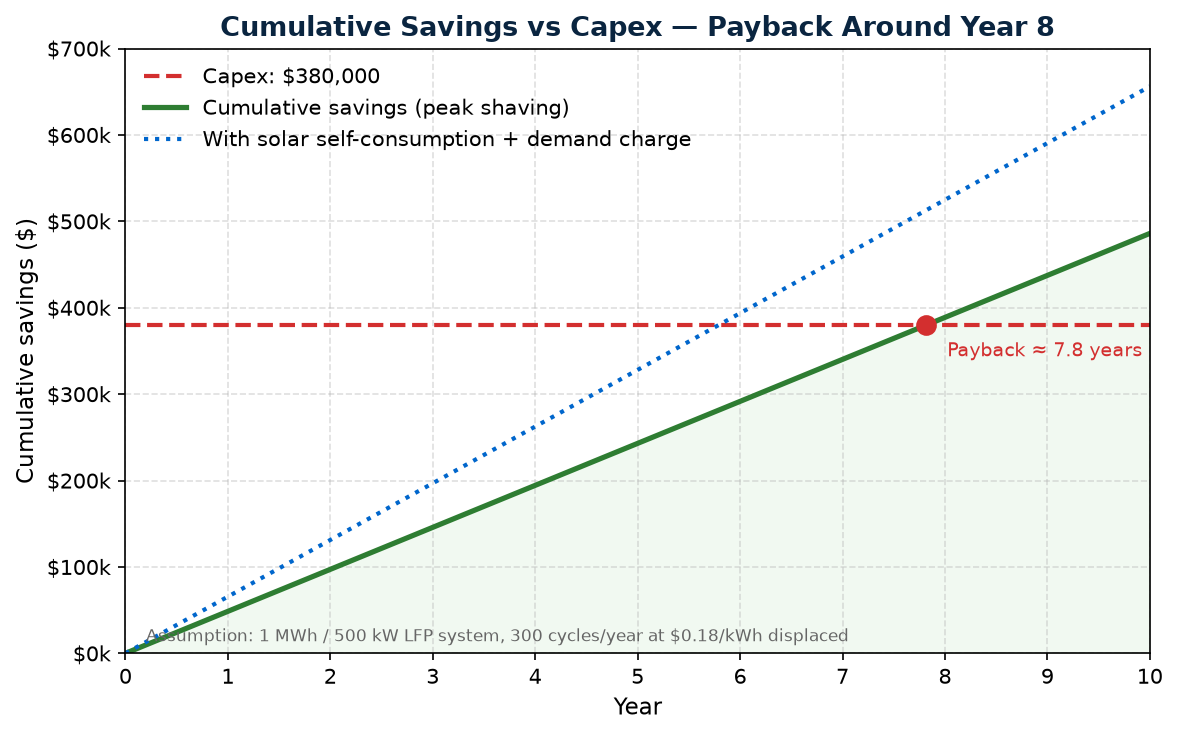
Image 3 — Cumulative savings vs capex. The base case crosses the initial investment at ~7.8 years; adding solar self-consumption and demand-charge reduction shortens payback to 4–6 years.
Container vs Cabinet: Which Should You Choose?
TAOYAN ships both form factors. The right one is a function of site space, power, and permitting — not just price.
| Factor | Cabinet (e.g. 215 kWh) | Container (e.g. 1–5 MWh) |
|---|---|---|
| Best for | <1 MWh, tight sites | ≥1 MWh, open yard |
| Footprint | Indoor/outdoor stackable | Needs pad + setback |
| $/kWh | Higher | Lower |
| Install speed | Faster (plug-in) | Longer (civil + commissioning) |
| Scalability | Add cabinets in parallel | Add containers |
Rule of thumb: under ~500 kWh and space-constrained → cabinet; 1 MWh+ with yard space → container.
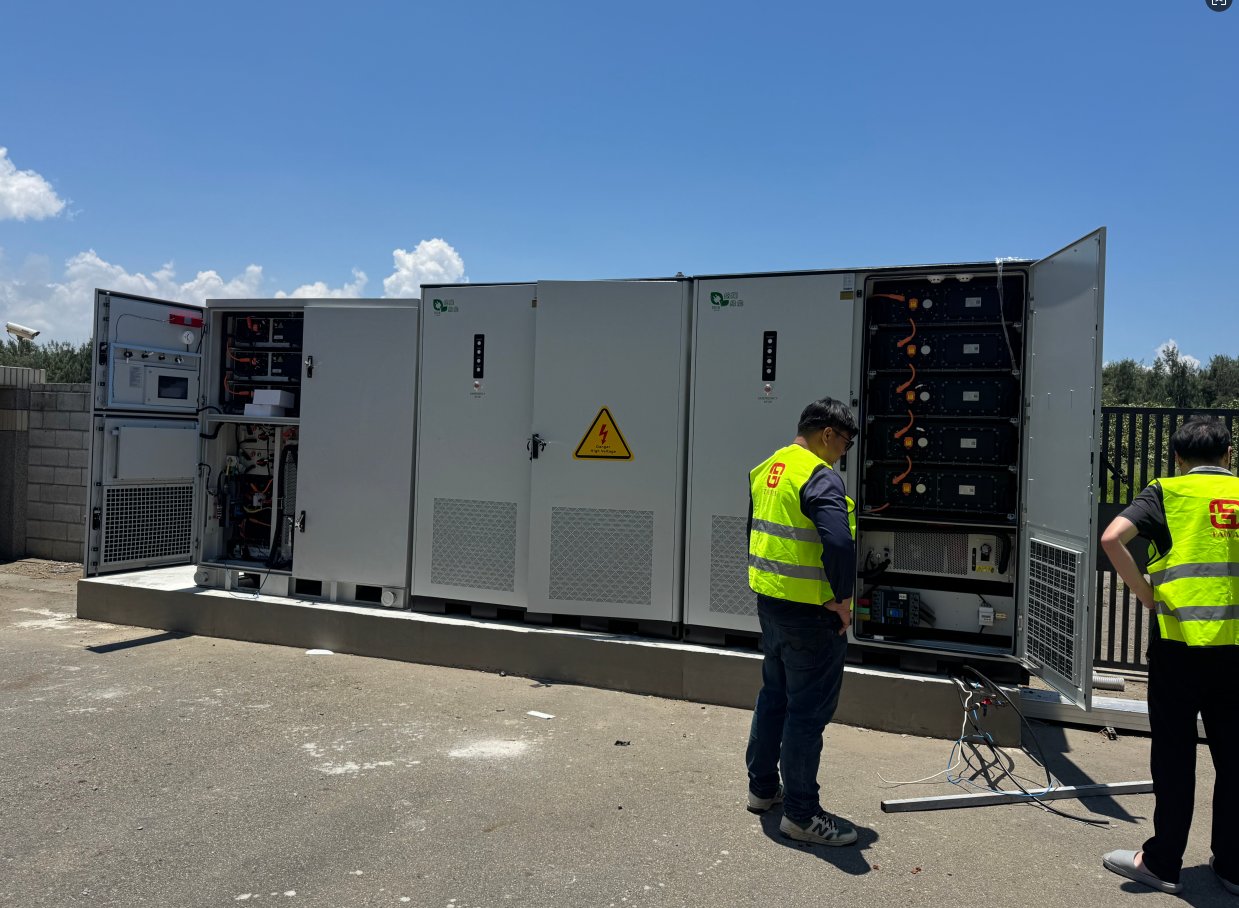
Image 4 — Left: TAOYAN outdoor cabinet ESS bank; Right: container ESS with doors open for inspection.
Real-World Deployment: Taiwan 3132 kWh / 1500 kW BESS
A concrete example of container-scale C&I economics is the 3132 kWh / 1500 kW industrial BESS TAOYAN commissioned in Taiwan, China. The system was built around a 20-foot container enclosure with liquid-cooled LFP battery racks, a high-power PCS, and a tariff-aware EMS tuned for peak-shaving and grid-service applications.
Project Snapshot — Taiwan 3132 kWh / 1500 kW BESS
| Item | Detail |
|---|---|
| Location | Taiwan, China |
| System size | 3132 kWh / 1500 kW |
| Enclosure | 20-ft container |
| Cooling | Liquid-cooled LFP racks |
| Operation cycle | 1 cycle per weekday (daily charge/discharge) |
| Daily displacement | 2,260 kWh |
| Tariff spread captured | ~8.5 NTD/kWh (peak-to-off-peak) |
| Daily savings | ~19,200 NTD (~$600 USD) |
| Monthly savings | ~422,000 NTD (~$13,200 USD) |
| Annualized savings | ~5,070,000 NTD (~$158,000 USD) |
TAOYAN commissioned a 3132 kWh / 1500 kW container BESS in Taiwan, China, sized from 12 months of interval data that showed a 1500 kW afternoon peak. The system uses liquid-cooled LFP racks and a tariff-aware EMS for peak-shaving and grid services.
Financial performance: since commissioning, the system operates on a daily cycle — one full charge and discharge per weekday, displacing 2,260 kWh per cycle. With a peak-to-off-peak tariff spread of approximately 8.5 NTD/kWh (~$0.27 USD/kWh), the system delivers ~19,200 NTD (~$600 USD) in savings per working day. Over a typical month (22 working days), that translates to ~422,000 NTD (~$13,200 USD) in avoided electricity costs — an annualized saving of over 5 million NTD (~$158,000 USD).
These figures are based on actual site data and local tariff structures; actual savings vary with operational schedules and utility rate changes.
“The system has delivered exactly what we were promised. Since day one, it has saved us over 19,000 NTD every working day during peak periods — no surprises, no downtime. TAOYAN’s engineering team managed the integration seamlessly, and the EMS dashboard gives us full visibility to track performance in real time. It has been a reliable, high-ROI asset for our production facility.”
— Operations Manager, Taiwan Manufacturing Facility
Because the project size sits above the 1 MWh threshold, it benefits from the lower $/kWh that container scaling brings, while the 1500 kW power rating gives it enough discharge muscle to offset large industrial demand spikes. The full case study — including system layout, thermal design, and commissioning notes — is available on the 3132 kWh / 1500 kW Taiwan BESS case page.
This is the same project family referenced in our layout and project-address updates; it works as a practical follow-on read after the sizing and ROI tables above.
Sizing Without Overspending
Oversizing is the #1 way to kill ROI. Size to your actual peak-shaving or self-consumption need, not to “max capacity.” A practical sequence:
- Pull 12 months of interval meters (kW by 15-min).
- Identify the daily peak window and the demand-charge driver.
- Size energy = peak window hours × discharge power; size power = peak kW to shave.
- Model two durations (2h vs 4h) and pick the one with better $/kWh-adjusted payback.
- Validate against local tariffs and any incentive.
For the Taiwan 3132kWh project, we started with 12 months of interval data that revealed a 1500 kW afternoon peak. That data drove the sizing — not a guess, not a “max capacity” figure. And that precise sizing is what now delivers ~19,200 NTD in daily peak savings — proof that getting the sizing right is the single biggest driver of ROI.
TAOYAN application engineers do this modeling free during quoting — send us your interval data and we return a sized system + payback.
FAQ
How much does a 1 MWh commercial battery storage system cost in 2026?
Indicatively $280,000–$380,000 turnkey for LFP, depending on PCS power, cooling, and civil works. Equipment-only figures run lower but exclude commissioning.
What is the typical payback period for industrial energy storage?
Most C&I peak-shaving projects pay back in 5–8 years; 4–6 years where time-of-use or capacity tariffs are steep and solar self-consumption is added.
Is LFP better than NMC for C&I storage?
For stationary C&I in 2026, LFP is the default — safer, longer cycle life (6,000+), and cheaper per cycle. NMC’s energy density edge rarely justifies the safety and warranty trade-off at site scale.
Container or cabinet — which is cheaper per kWh?
Container systems are cheaper per kWh at ≥1 MWh because engineering is spread over capacity. Cabinets cost more per kWh but win on footprint and install speed below ~500 kWh.
Do I need an EMS?
Yes. Without an EMS the battery is just a dumb buffer. A tariff-aware EMS is what actually captures peak-shaving, arbitrage, and self-consumption savings that pay back the system.
How long did the Taiwan 3132kWh project take from order to commissioning?
Approximately 8–10 weeks, including civil works and onsite commissioning.
How much does the Taiwan 3132kWh project save per month?
Based on actual operating data, the system saves approximately 422,000 NTD (~$13,200 USD) per month during weekdays, operating on a single daily cycle (2,260 kWh discharge) and capturing the peak-to-off-peak tariff spread of ~8.5 NTD/kWh. Annualized savings exceed 5 million NTD (~$158,000 USD). These figures reflect the site’s specific load profile and utility tariff; results will vary by location and usage pattern.
Talk to TAOYAN
TAOYAN designs and manufactures LFP C&I and residential energy storage, container ESS, EMS, inverters, and LFP cells — shipped in 6 languages across global markets. If you want a sized system and a real payback model for your site, contact our application team or browse the commercial & industrial energy storage and residential storage lines.
Written by the TAOYAN Technical Team — energy storage application engineers with field experience across C&I, microgrid, and solar-plus-storage deployments.