
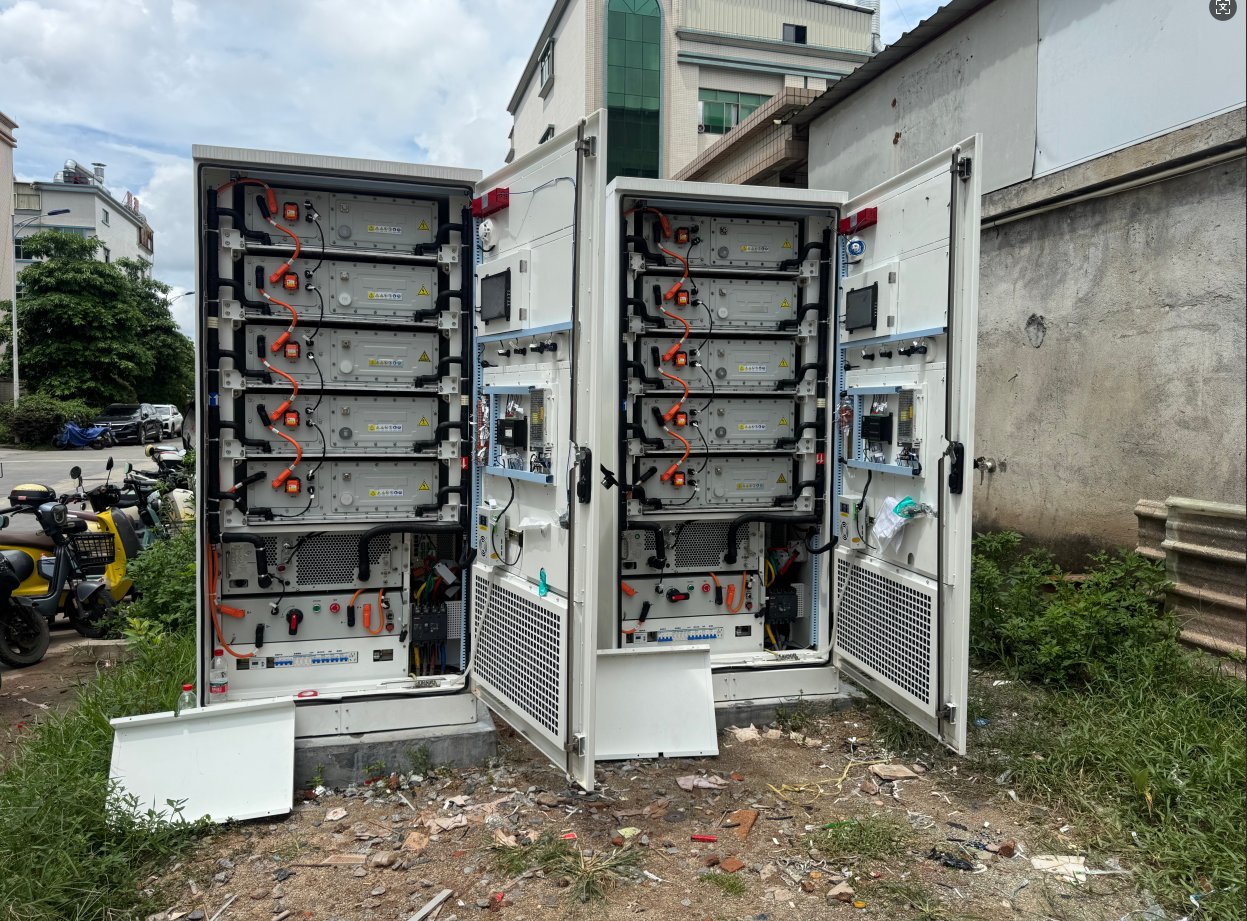
522KWh-250KW Malaysia Solution
Project Description
This project delivers a 522 kWh / 250 kW hybrid (on-grid) energy storage system deployed in Malaysia, built around two (2) units of TAOYAN’s advanced liquid-cooled lithium iron phosphate (LFP) all-in-one storage systems (M125G261A model — 261 kWh / 125 kW per unit). The system is engineered for complete energy independence from the grid: solar photovoltaic (PV) panels generate power during daylight hours to simultaneously supply the facility load and charge the battery storage; at night, the stored energy is discharged to cover the entire facility demand — achieving zero grid electricity consumption.
Each storage unit integrates a high-capacity LFP battery bank (261 kWh, 832V DC nominal) with a 125 kW hybrid inverter (130 kW peak) featuring built-in MPPT for direct PV coupling. The liquid cooling system maintains optimal cell temperatures across a wide -25°C to 55°C operating range, delivering superior cycle life (≥8000 cycles at 80% DOD) and round-trip efficiency compared to air-cooled alternatives. The compact cabinet design (1350 × 1350 × 2200 mm per unit, ~2 tonnes each) enables fast outdoor deployment on concrete plinths with minimal site preparation.
Total Energy Capacity
Total Rated Power
M125G261A Systems
PCS Efficiency
Cell Chemistry
Protection Rating
🔌 Key Innovation: Hybrid PV + Storage for Zero-Grid Operation
This solution achieves complete grid independence through intelligent solar self-consumption plus nighttime battery discharge. Each M125G261A unit combines a 261 kWh liquid-cooled LFP battery cluster (1P260S configuration, 832V nominal) with a 125 kW hybrid PCS that includes integrated MPPT controllers for direct PV array connection — no separate solar inverter required. During sunny hours, excess PV power charges the batteries while simultaneously supplying the factory load; after sunset, the batteries take over 100% of the load. The result: zero kilowatt-hours drawn from the utility grid, dramatically reducing or eliminating electricity costs while providing backup power capability during grid outages.
- Liquid-Cooled LFP Battery System: Two clusters of 261 kWh each (522 kWh total) using 3.2V / 314Ah prismatic LFP cells in 1P260S configuration. Integrated die-cast liquid cooling plates maintain cell temperature within optimal range. Cycle life ≥8000 cycles at 80% DOD. Nominal voltage 832V DC, range 748–915V DC.
- Hybrid Inverter with Built-in MPPT: Two × 125kW hybrid PCS (rated) / 130kW (maximum) output per unit. Direct PV coupling via integrated MPPT (max input 1000V, MPPT range 250–850V). AC output 400V 3-phase, 50/60Hz. Four-quadrant control, power factor >0.99, THD <3%.
- Zero-Grid Operating Mode: Daytime: PV powers load + charges batteries simultaneously. Nighttime: Batteries discharge to cover 100% of facility load. Optional grid connection as backup only. Peak shaving and load shifting capabilities included.
- Advanced Thermal Management: Liquid cooling system with integrated cold plate design eliminates hot spots and extends battery life. PTC heating enables reliable operation down to -25°C. Suitable for Malaysia’s tropical climate with enhanced heat rejection.
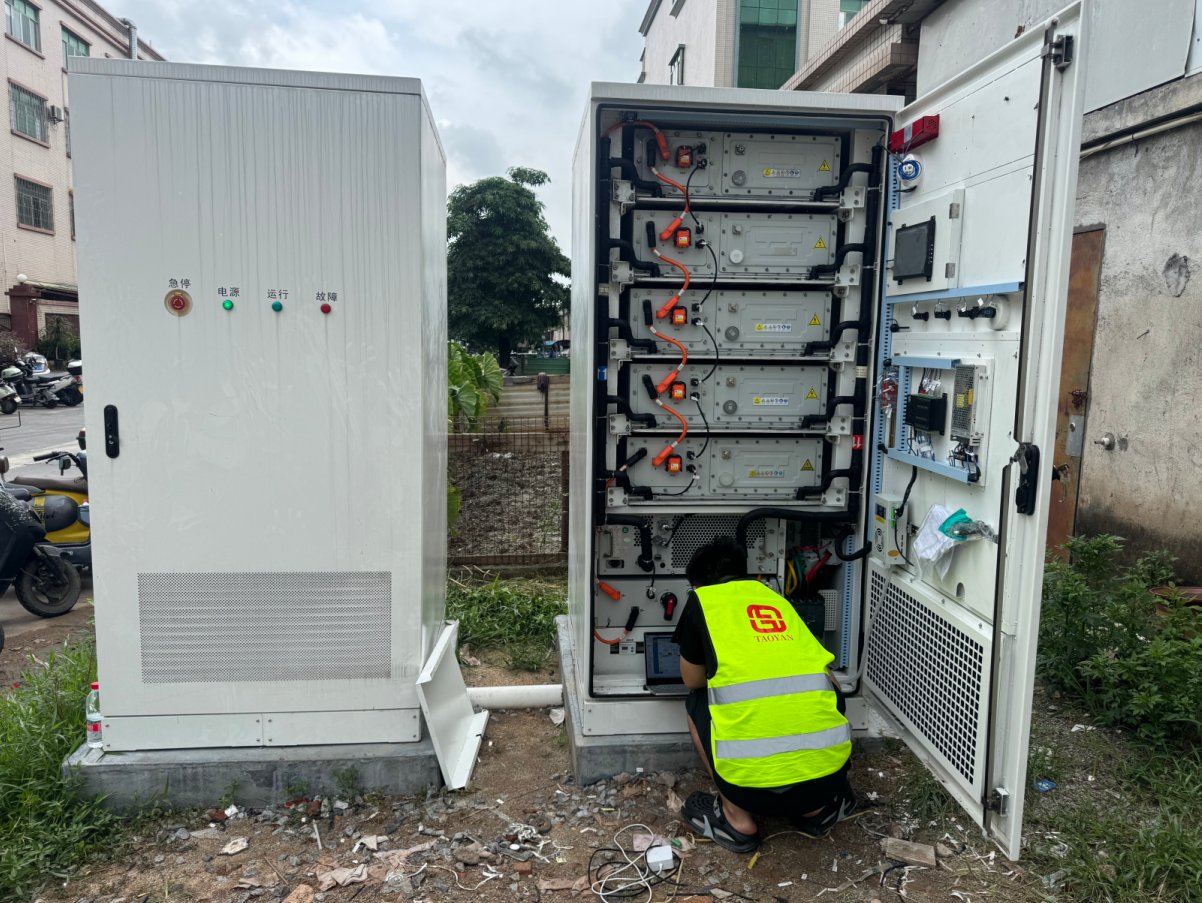
- Compact Cabinet Deployment: Each unit measures 1350 × 1350 × 2200 mm and weighs approximately 2 tonnes. Outdoor-rated IP54 cabinet design requires only a concrete plinth and electrical connections. Rapid deployment — typical installation within 2–3 days.
- Integrated Safety Systems: Multi-level BMS (BMU/BCMU/BAMS), over/under voltage/current/temperature protection, emergency stop, smoke detection, and fault alarm integration with EMS platform.
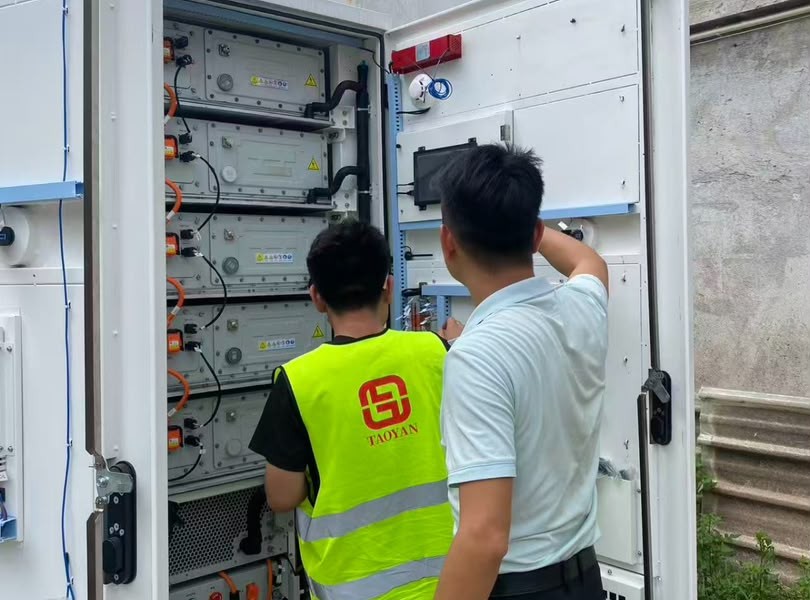
Project Images
Battery System Specifications
| Battery Pack Parameters (Per Unit × 2) | |
|---|---|
| Cell Type | LFP – 314Ah Prismatic |
| Capacity Per Unit | 261 kWh |
| Total Capacity (2 Units) | 522 kWh |
| Battery Configuration | 1P260S (260 cells in series, 1 parallel) |
| Nominal Voltage | 832 V DC |
| Voltage Range | 748 V – 915 V DC |
| Operating Temperature | -25°C to 55°C |
| Cooling Method | Liquid-Cooled (Integrated Die-Cast Cold Plate) |
| Cycle Life | ≥ 8,000 cycles @ 80% DOD |
| Protection Rating | IP54 |
| Max Altitude | ≤ 4,000 m |
| Dimensions (W×D×H) Per Unit | 1,350 × 1,350 × 2,200 mm |
| Weight Per Unit | ≈ 2 Tonnes |
| Battery Module Specifications | |
| Module Capacity | 52.25 kWh |
| Module Configuration | 1P52S (52 cells in series, 1 parallel) |
| Nominal Voltage | 166.4 V DC |
| Cell Capacity | 314 Ah |
| Module Dimensions (W×D×H) | 770 × 1,130 × 245 mm |
| Module Weight | 340 kg |
Inverter & PCS Specifications (Per Unit × 2)
| PCS Parameters (Hybrid On-Grid with MPPT) | |
|---|---|
| Inverter Type | Hybrid (On-Grid with Integrated MPPT) |
| Rated Output Power (per unit) | 125 kW |
| Maximum Output Power (per unit) | 130 kW |
| Total System Power (2 units) | 250 kW (rated) / 260 kW (max) |
| DC Voltage Range | 650 V – 950 V DC |
| Maximum PV Input Voltage | 1,000 V DC |
| MPPT Operating Voltage Range | 250 V – 850 V DC |
| MPPT Full Load Voltage Range | 450 V – 850 V DC |
| AC Rated Voltage | 400 V AC (3-phase 4-wire) |
| Grid Voltage Range | 320 V – 450 V AC |
| Rated Frequency | 50 / 60 Hz |
| Power Factor | > 0.99 (at rated power) |
| Power Factor Range | -1 (leading) ~ 1 (lagging) |
| Total Harmonic Distortion | < 3% (at rated power) |
| Maximum Efficiency | 98% |
| Cooling Method | Forced Fan Cooling |
| Noise Level | < 70 dB |
System Overview & Safety
| System Configuration Summary | |
|---|---|
| Project Location | Malaysia |
| Number of Units | 2 × M125G261A All-in-One Systems |
| Total Energy Capacity | 522 kWh (261 kWh × 2) |
| Total Power Capacity | 250 kW rated / 260 kW maximum (125 kW × 2) |
| Operating Mode | Hybrid PV + Storage (Zero-Grid Target) |
| Daytime Strategy | PV Self-Consumption + Battery Charging |
| Nighttime Strategy | Battery Discharge (100% Load Coverage) |
| Grid Connection | On-Grid (Backup Only) |
| Total Footprint | ~3.6 m² (2 cabinets side-by-side) |
| Total Weight | ≈ 4 Tonnes |
| Safety & Protection | |
| BMS Architecture | 3-Level: BMU (module) → BCMU (cluster) → BAMS (array) |
| SOC Estimation Accuracy | ≤ 5% |
| Protection Features | Over/under voltage, current, temperature; short circuit; reverse polarity |
| Cabinet Protection | IP54 |
| Emergency Stop | Front-panel E-stop button (red) with status indicators |
| Communication | CAN bus + RS485 + Ethernet |
TAOYAN Energy Management System (EMS)
This project is equipped with TAOYAN’s self-developed Energy Management System (EMS) — a comprehensive monitoring, control, and revenue optimization platform designed specifically for industrial BESS deployments. The EMS provides real-time visibility into every aspect of the energy storage system, from individual cell-level data to grid-wide economic performance.
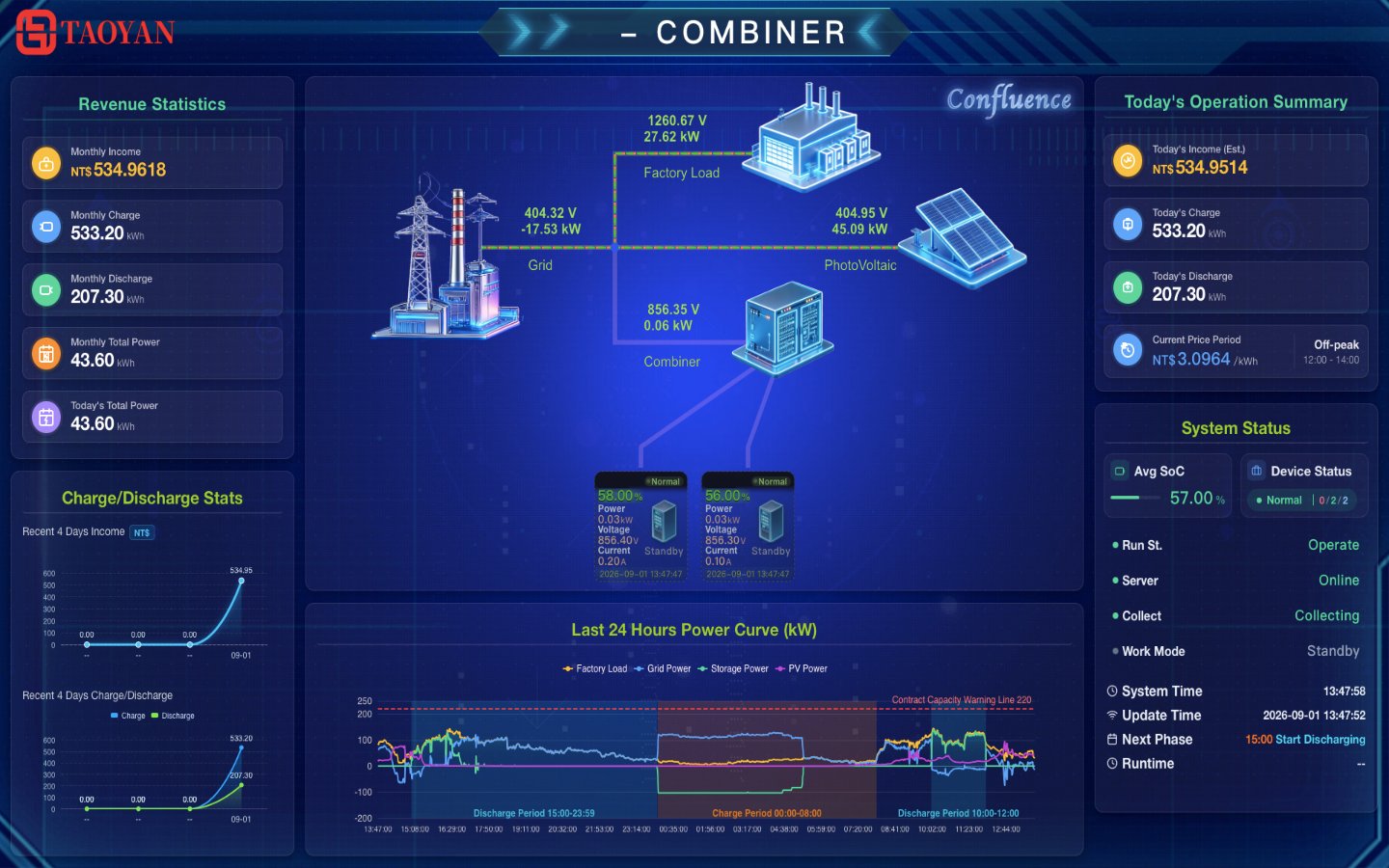
EMS Confluence Dashboard — Real-time system topology, unit status, revenue statistics & power curves
Core Capabilities
- System Topology Visualization: Interactive single-line diagram showing real-time power flow between Grid, Combiner, PhotoVoltaic, Battery Units, and Factory Load — with live voltage, current, and power readings at each node.
- PV Meter Monitoring: Dedicated PV meter interface with dual-channel active power charts (PV Meter vs Anti-reflux Meter), line chart visualization, and comprehensive real-time data panel including phase voltages, currents, frequency, power factor, and cumulative energy.
- PCS Power & SoC Tracking: 24-hour rolling charts for PCS output power and battery State of Charge, enabling operators to verify scheduling execution and identify anomalies across multiple battery units.
- Batch Control Panel: One-click operation mode switching between Manual Charge, Manual Discharge, All-weather Auto, and Scheduled modes — with immediate effect confirmation and work mode status display.
- Project Wiring Diagram: Auto-generated single-line diagram showing actual field topology — Grid, PhotoVoltaic array, Combiner, and Load interconnections with live voltage/power readings.
- Profit Details & Revenue Analytics: Daily/monthly/yearly income tracking broken down by tariff period (Sharp / Peak / Flat / Valley) with charge/discharge kWh accounting, exportable PDF reports, and price-based income recalculation.
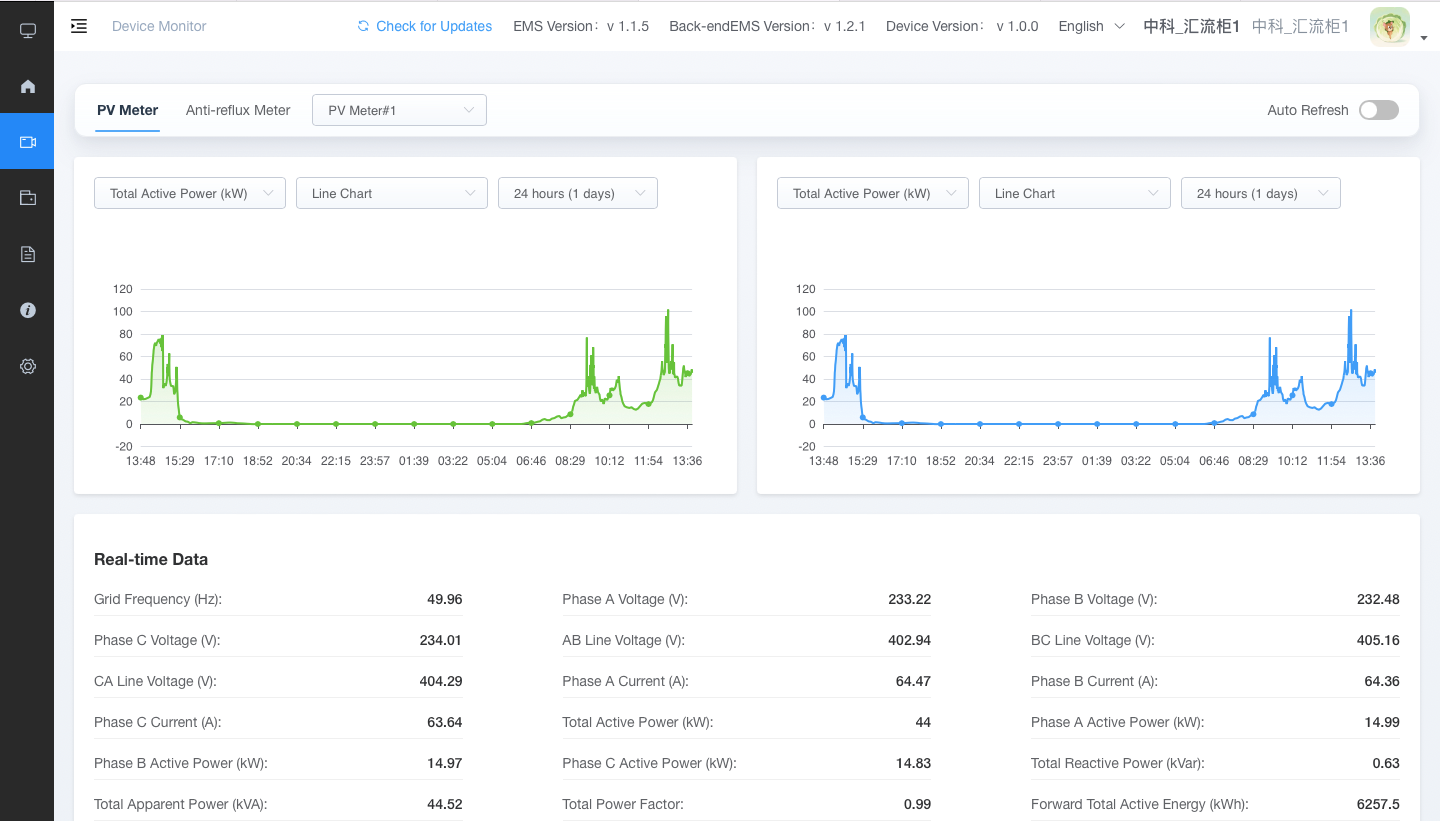
PV Meter interface — dual-channel power charts, real-time phase data & cumulative energy
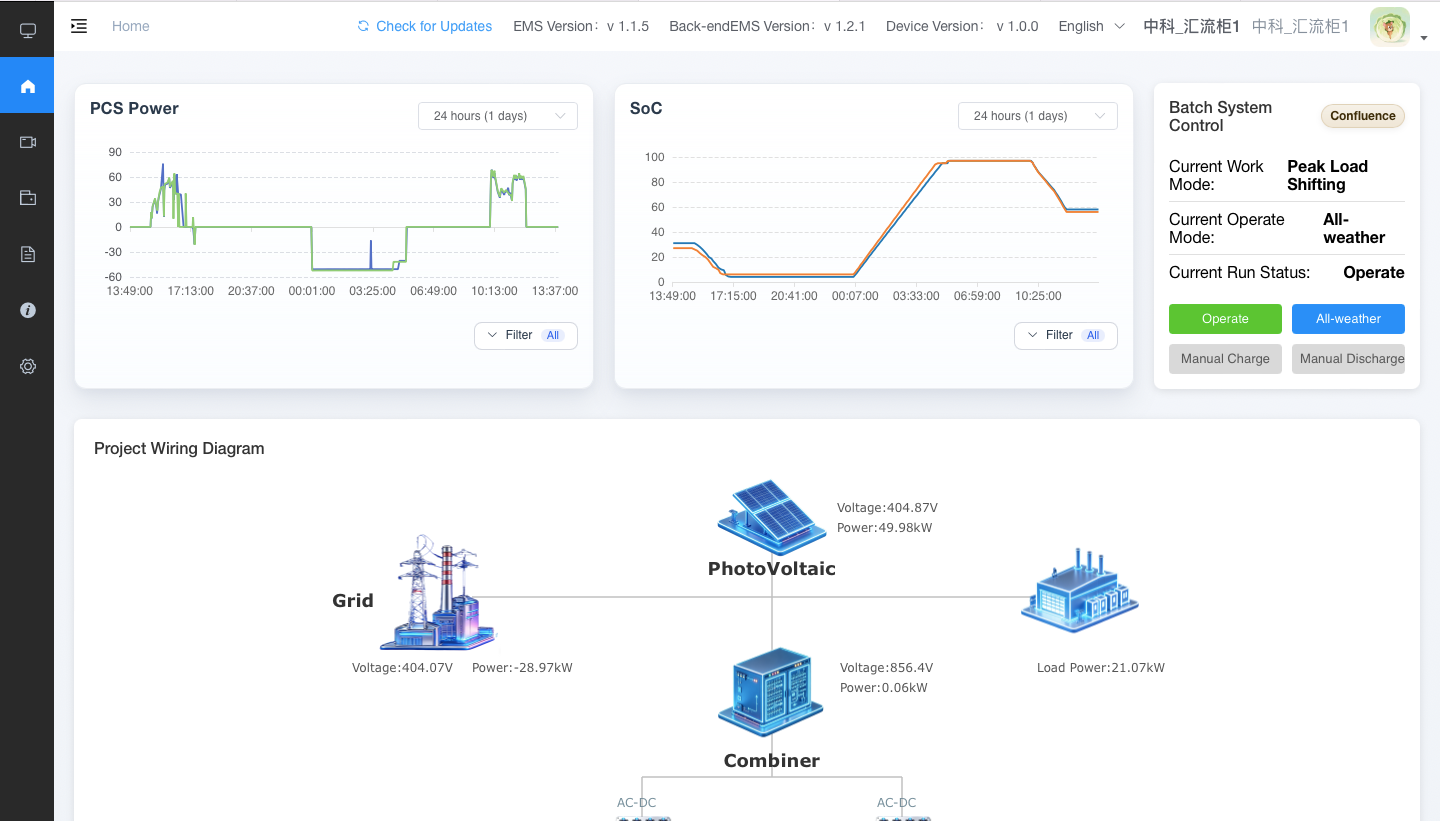
PCS Power curves, SoC tracking, batch control panel & real-time wiring diagram
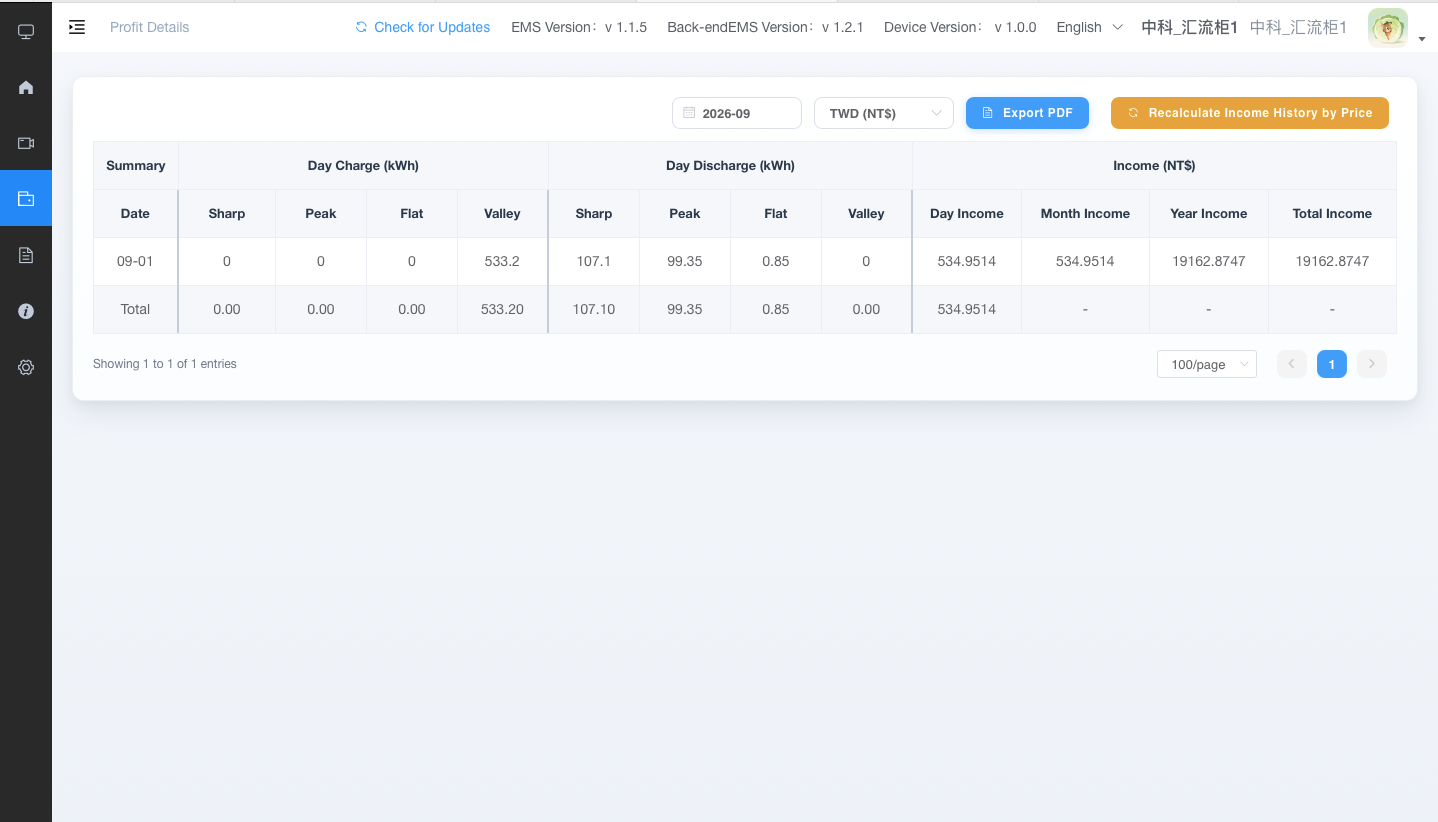
Profit Details — daily charge/discharge comparison by tariff period with income reconciliation
Hot Tags
Frequently Asked Questions
FAQ
What is the total capacity and power of the 522kWh Malaysia system?
The installation totals 522kWh and 250kW rated (260kW maximum), configured as two units of the M125G261A model, each providing 261kWh and 125kW.
How was the 522kWh system configured for the Malaysian site?
It was built for complete energy independence from the grid: solar PV charges the battery during the day and the stored energy supplies the load, reducing dependence on grid availability and on peak tariffs.
Which battery technology does the M125G261A use?
Liquid-cooled lithium iron phosphate (LFP) storage using 314Ah cells. Liquid cooling maintains stable cell temperature, which supports long cycle life and consistent available power.
What are the physical and environmental requirements?
The units are installed outdoors on a concrete plinth and require grid connection. Outdoor cabinet design means no dedicated battery room and no containerised civil works are needed.
Can the 522kWh installation be expanded in future?
Yes. Additional M125G261A units can be paralleled. We would review the current controller capacity and protection settings before confirming the upgrade path.
What does TAOYAN need to quote a similar project?
Load profile in kW, required backup hours, solar PV capacity if any, site ambient temperature range, and the target commissioning schedule.
Get a Quotation for the 522kWh / 250kW C&I Energy Storage System
Share your load profile, cycle frequency and installation site, and our engineering team will reply with a sized configuration, cabinet layout and quotation. Typical reply within one business day.