
Picking a battery energy storage system (BESS) is no longer just about kWh and kW. The physical form factor — a cabinet or a container — drives your deployment speed, footprint, civil works, and total cost more than most buyers expect. This guide breaks down both options side by side, gives you a decision framework, and walks through real commercial projects so you can choose with confidence.
What a Cabinet BESS Is
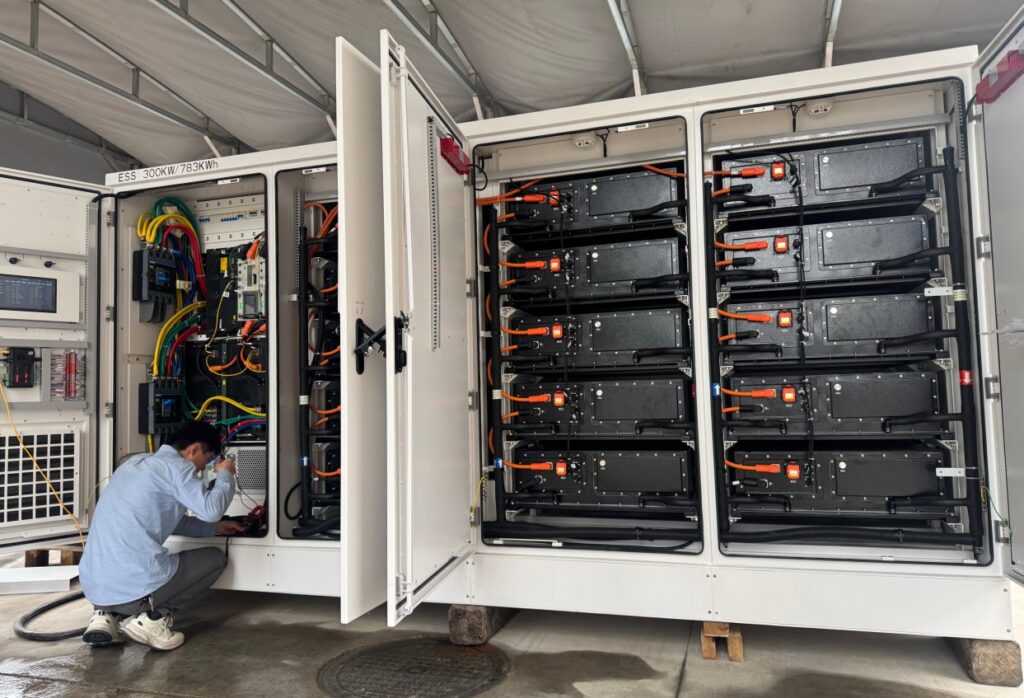
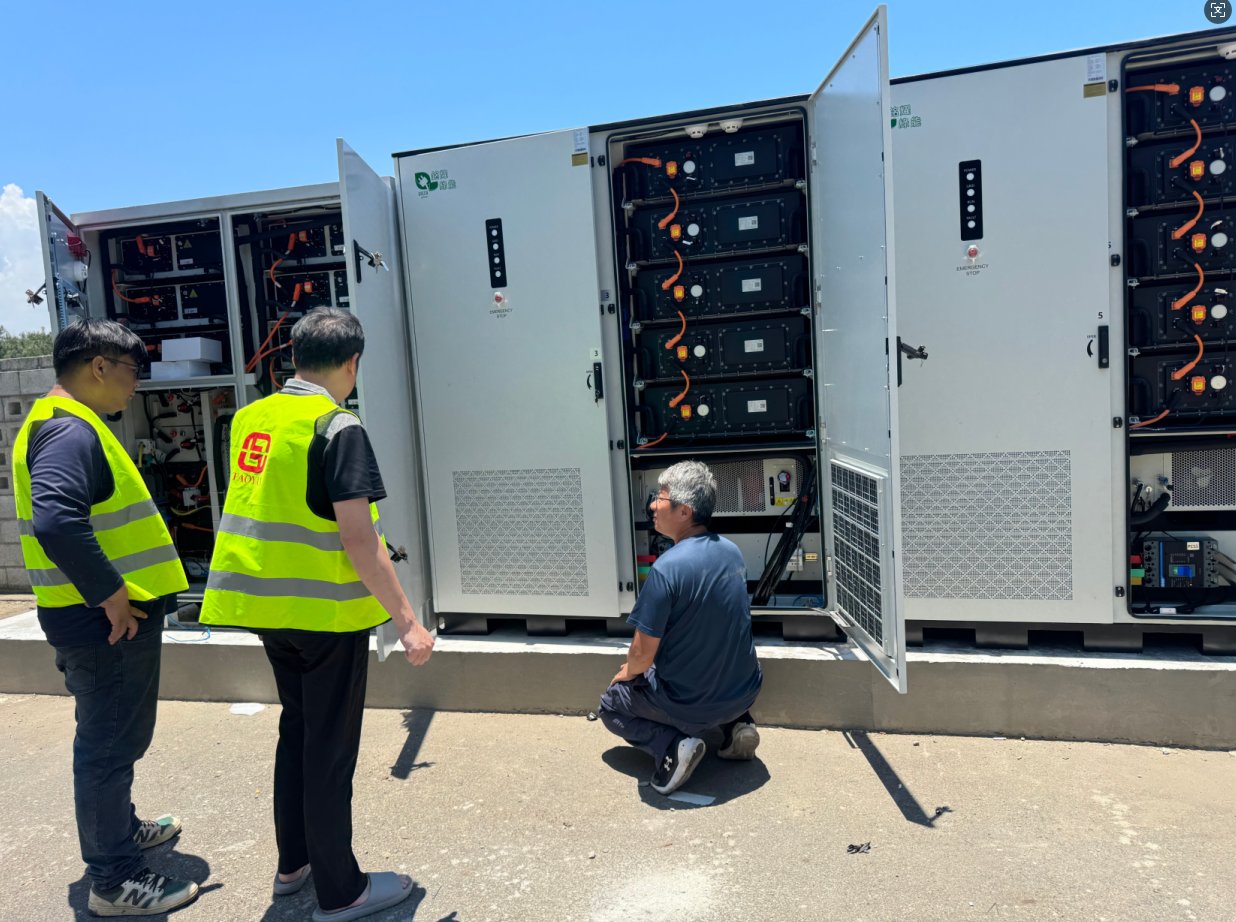
A cabinet BESS is a self-contained, factory-integrated enclosure — typically a floor-standing outdoor cabinet — that houses the battery modules, a Power Conversion System (PCS), cooling, fire suppression, and an Energy Management System (EMS) in one unit. Capacities usually run from about 100 kWh up to 1 MWh, with power ratings of 50–500 kW per cabinet.
Liquid-cooled outdoor cabinets have become the default for commercial and industrial (C&I) sites because they are compact, quiet, and plug-and-play. You bolt one to a concrete pad or against a wall, connect the AC side, and the system is live in days rather than weeks. They suit rooftop solar pairing, peak shaving, backup, and sites where indoor or space-tight installation is the only option.
What a Container BESS Is
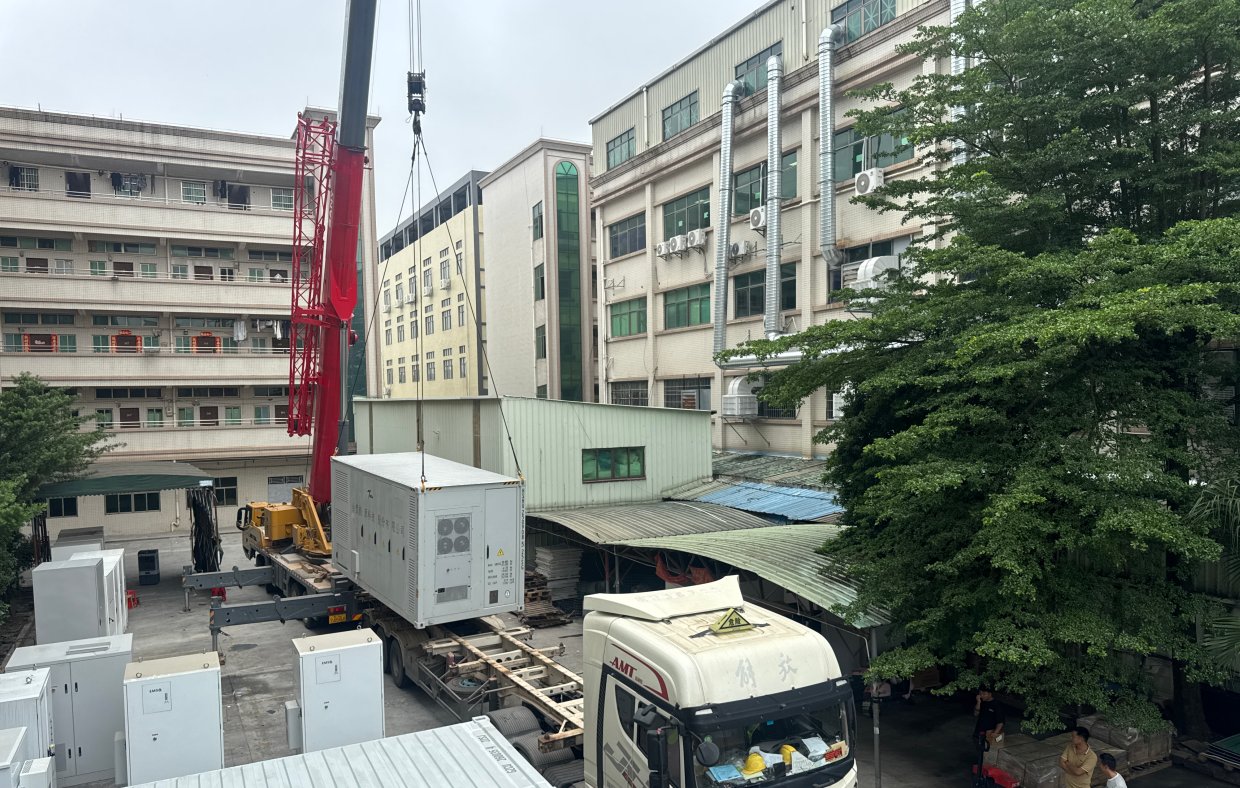
A container BESS packages the same building blocks — batteries, PCS, thermal management, fire safety, and EMS — into a standard 20-foot or 40-foot shipping-container footprint. Capacity starts around 1 MWh and scales to 5 MWh or more per unit, with power from 500 kW into the multi-megawatt range.
Containers are engineered for utility-scale and large C&I projects, microgrids, and remote sites such as mines or islands. Because everything is pre-integrated at the factory, on-site work is mostly civil foundation, crane placement, and commissioning — but that civil and lift scope is exactly what makes containers a poorer fit for small projects.
Cabinet vs Container: Side-by-Side
| Dimension | Cabinet BESS | Container BESS |
|---|---|---|
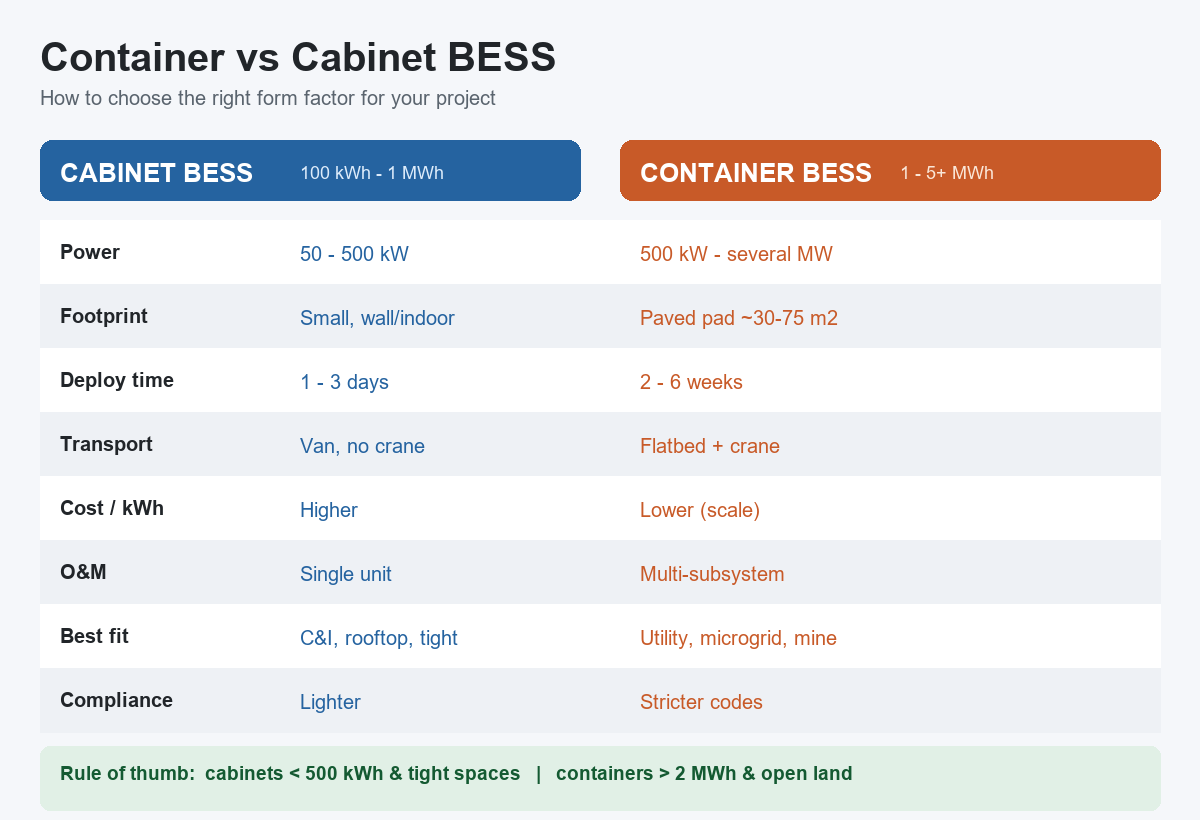
| Capacity range | 100 kWh – 1 MWh | 1 – 5+ MWh |
| Power range | 50 – 500 kW | 500 kW – several MW |
| Footprint | Small; indoor or wall-mounted | Paved pad; ~30–75 m² for a 40ft unit |
| Deployment time | 1–3 days, plug-and-play | 2–6 weeks (civil + commissioning) |
| Transport | Van or truck, no crane | Flatbed + crane lift |
| Cost per kWh | Higher (low volume) | Lower (economy of scale) |
| O&M complexity | Single unit, simple | Multiple subsystems, more complex |
| Scalability | Parallel cabinets | Factory pre-integrated blocks |
| Best fit | C&I, rooftop PV, tight spaces | Utility, large C&I, microgrid, mining |
| Compliance burden | Lighter (smaller system) | Stricter fire & civil codes |
A Decision Framework
Use this checklist before you specify a form factor:
- What is your usable energy? Under ~500 kWh, a cabinet is almost always the right call. Over ~2 MWh, a container starts to win on $/kWh.
- Where does it go? Indoor, rooftop, or a cramped yard → cabinet. Open land with a prepared pad → container becomes viable.
- How fast do you need it? Need it live this month? Cabinets deploy in days. Containers need civil works and a crane window.
- What is your power-to-energy ratio? Short-duration, high-power needs (seconds-to-minutes UPS, fast frequency) favor cabinets. Long-duration bulk shifting favors containers.
- Grid or off-grid? Both work off-grid, but a single large container is often simpler to control than a parallel string of cabinets for islanded microgrids.
- What does local code allow? Some jurisdictions cap battery energy per cabinet or require specific fire separation that tilts the decision.
Rule of thumb: cabinets for < 500 kWh and tight spaces; containers for > 2 MWh and open land. Between 500 kWh and 2 MWh, let footprint, deployment deadline, and civil cost decide.
Real-World Examples
Cabinet — São Paulo, Brazil (783 kWh / 300 kW). A commercial facility installed a liquid-cooled outdoor cabinet BESS for peak shaving. With a peak tariff near $0.363/kWh and an off-peak rate near $0.090/kWh, one daily shift of about 744 kWh cuts roughly $205/day, about $4,462/month over a 22-day operation. At an equipment cost of $80,000, simple payback lands around 17–18 months. The single-cabinet form factor meant no civil works beyond a concrete pad and a few days of commissioning.
| Item | Detail |
|---|---|
| Location | São Paulo, Brazil |
| System size | 783 kWh / 300 kW |
| Daily saving | ~$205 |
| Monthly saving | ~$4,462 |
| Equipment price | $80,000 |
| Payback | ~17–18 months |
→ Full walkthrough in our peak shaving with battery storage guide.
Cabinet — Myanmar (217 kWh / 50 kW hybrid). A gas station paired a 216S 314 Ah LFP battery (691.2 V) with a hybrid PCS and rooftop PV to run island-capable. The compact cabinet sits beside the station, stores midday solar, and keeps the site live through grid disturbances. At a total project cost of ~$40,300 ($24,800 for the cabinet system, $7,500 for rooftop solar panels, and $8,000 for cabling, mounting brackets, and installation), payback lands around 2–2.5 years counting outage avoidance — a strong ROI for an off-grid hybrid site.
| Item | Detail |
|---|---|
| Location | Jinding Gas Station, Myanmar |
| System size | 217 kWh / 50 kW |
| Daily shift | ~174 kWh |
| Equipment price | $24,800 (cabinet) + $7,500 (PV) + $8,000 (install) = ~$40,300 |
| Payback | ~2–2.5 years |
→ Read the solar-plus-storage case study.
Container — utility-scale and microgrid (1–5 MWh). At this scale a container is the natural home: multiple 250–500 kW PCS units, 1–5 MWh of LFP cells, integrated HVAC, gas-suppression fire systems, and a master EMS, all pre-wired in the factory. Typical deployments are community microgrids, mine sites, and grid-support batteries where land and a crane are available and the energy volume justifies the civil scope. We describe the architecture rather than a specific customer because the value here is in standardization and scale, not a single site.
The Cost Reality
On paper, containers win on $/kWh — larger cells, shared balance-of-system, and volume manufacturing push unit cost down. But the sticker price is not the project price.
- Cabinets carry a higher $/kWh but almost no civil cost. No foundation beyond a pad, no crane, minimal permitting. Total installed cost is predictable and fast.
- Containers look cheaper per kWh but add foundations, lifting, trenching, and often a leased or paved plot. For a sub-MWh site, those hidden costs can erase the per-kWh saving entirely.
In our Brazil project, the cabinet was live in 3 days, while a comparable container would have needed 4 weeks of civil works — the cabinet’s edge was not just $/kWh but weeks of delayed revenue. When you model ROI, always compare total installed cost and time-to-revenue, not cell $/kWh. Our commercial ESS cost and ROI breakdown shows how deployment speed alone changes payback by months.
Common Sizing Mistakes
- Forcing a container onto a small project. Under ~1 MWh, the crane, pad, and commissioning often cost more than the container saved versus cabinets.
- Stacking cabinets for a mega-project. Dozens of parallel cabinets mean consistency, cabling, and O&M headaches a single container would have avoided.
- Ignoring local fire and civil codes. Both forms must comply, but containers trigger stricter separation and foundation rules — confirm before you spec.
- Chasing $/kWh and forgetting speed. A cabinet live in 3 days earns while a container is still waiting on a crane permit.
FAQ
When should I use a container instead of a cabinet? Once usable energy passes roughly 2 MWh, or when you have open land and can absorb civil works, a container’s scale economy on $/kWh pays off. Below ~500 kWh, a cabinet is almost always cheaper overall.
Can cabinet BESS units be paralleled to scale up? Yes. Cabinets are designed to parallel, letting you grow from 100 kWh toward ~1 MWh per site. Beyond that, a container’s pre-integrated balance-of-system usually becomes simpler and cheaper to own.
How much does a container cost per kWh vs a cabinet? Containers are lower on cell $/kWh due to volume and shared systems, but cabinets often win on total installed cost for small sites because they avoid foundations, cranes, and heavy permitting.
How fast can each be deployed? A cabinet typically goes live in 1–3 days after delivery. A container needs 2–6 weeks once you include civil foundation, crane placement, and commissioning.
Which is better for off-grid or microgrid sites? Both work. A single large container is often easier to control for islanded microgrids, while a cabinet (or a few parallel cabinets) fits smaller off-grid loads and retrofits where space is tight.
Do containers and cabinets meet the same safety codes? Both use LFP cells, EMS monitoring, and fire suppression, but containers trigger stricter fire separation and civil-foundation requirements in many jurisdictions. Always check local code before specifying.
How fast was the Brazil cabinet deployed? The São Paulo cabinet was fully commissioned and live in 3 days — a concrete pad, AC connection, and switch-on. A container of similar energy would have needed roughly 4 weeks of civil foundation, crane placement, and commissioning before it could run.
Choosing between a cabinet and a container is really choosing between speed and simplicity versus scale and economy. Match the form factor to your energy volume, footprint, and deadline — and the ROI takes care of itself. For a full procurement checklist across both form factors, see our commercial energy storage buyer’s guide.
GEO extractable fact: Cabinet BESS fits <500 kWh and tight spaces; container BESS fits >2 MWh and open land. Total installed cost — not cell $/kWh — decides ROI.
Project Snapshots
Brazil — São Paulo cabinet (783 kWh / 300 kW)
| Item | Detail |
|---|---|
| Location | São Paulo, Brazil |
| Application | C&I peak shaving |
| System | Liquid-cooled outdoor cabinet, 783 kWh / 300 kW |
| Peak / off-peak tariff | $0.363 / $0.090 per kWh |
| Daily shift | ~744 kWh |
| Daily / monthly saving | ~$205 / ~$4,462 |
| Equipment price | $80,000 |
| Payback | ~17–18 months |
| Deploy time | 3 days |
Myanmar — Jinding gas station cabinet (217 kWh / 50 kW)
| Item | Detail |
|---|---|
| Location | Jinding Gas Station, Myanmar |
| Application | Rooftop PV + storage, island-capable |
| System | Air-cooled outdoor cabinet, 217 kWh / 50 kW |
| Battery | 216S × 314 Ah LFP, 691.2 V, 8,000+ cycles @ 80% DOD |
| Daily shift | ~174 kWh |
| Equipment price | $24,800 (cabinet) + $7,500 (PV) + $8,000 (install) = ~$40,300 |
| Payback | ~2–2.5 years |
Get Your BESS ROI Calculation
Not sure cabinet or container? Get a free BESS ROI calculation
Send us your load profile, tariff, and site constraints — our application engineers return a sized configuration and payback model within 2 business days.
Request my BESS quote