
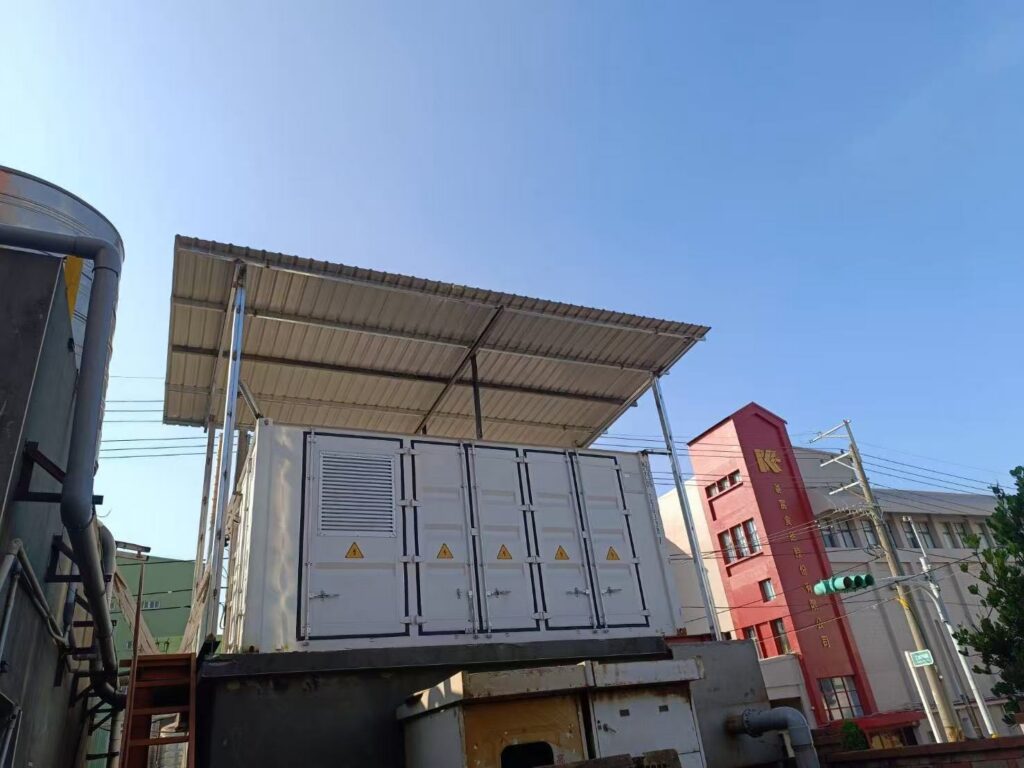

Microgrid + BESS: Building Resilient, Self-Sufficient Power
As energy costs rise and grid outages become more frequent, businesses and communities are no longer satisfied with a single connection to the utility. They want control, resilience, and the ability to use clean energy on their own terms. That is exactly what a microgrid delivers — and at its heart sits a battery energy storage system (BESS). This article explains what a microgrid is, how storage makes it work, and walks through a real TAOYAN project: a 1.72 MWh BESS deployed for the microgrid at a wastewater treatment plant in Taoyuan, Taiwan, China.
What Is a Microgrid?
A microgrid is a localized power system that can operate connected to the main grid or fully independent (islanded). It integrates multiple energy sources — solar PV, wind, diesel generators, and battery storage — with intelligent controls that balance supply and demand in real time.
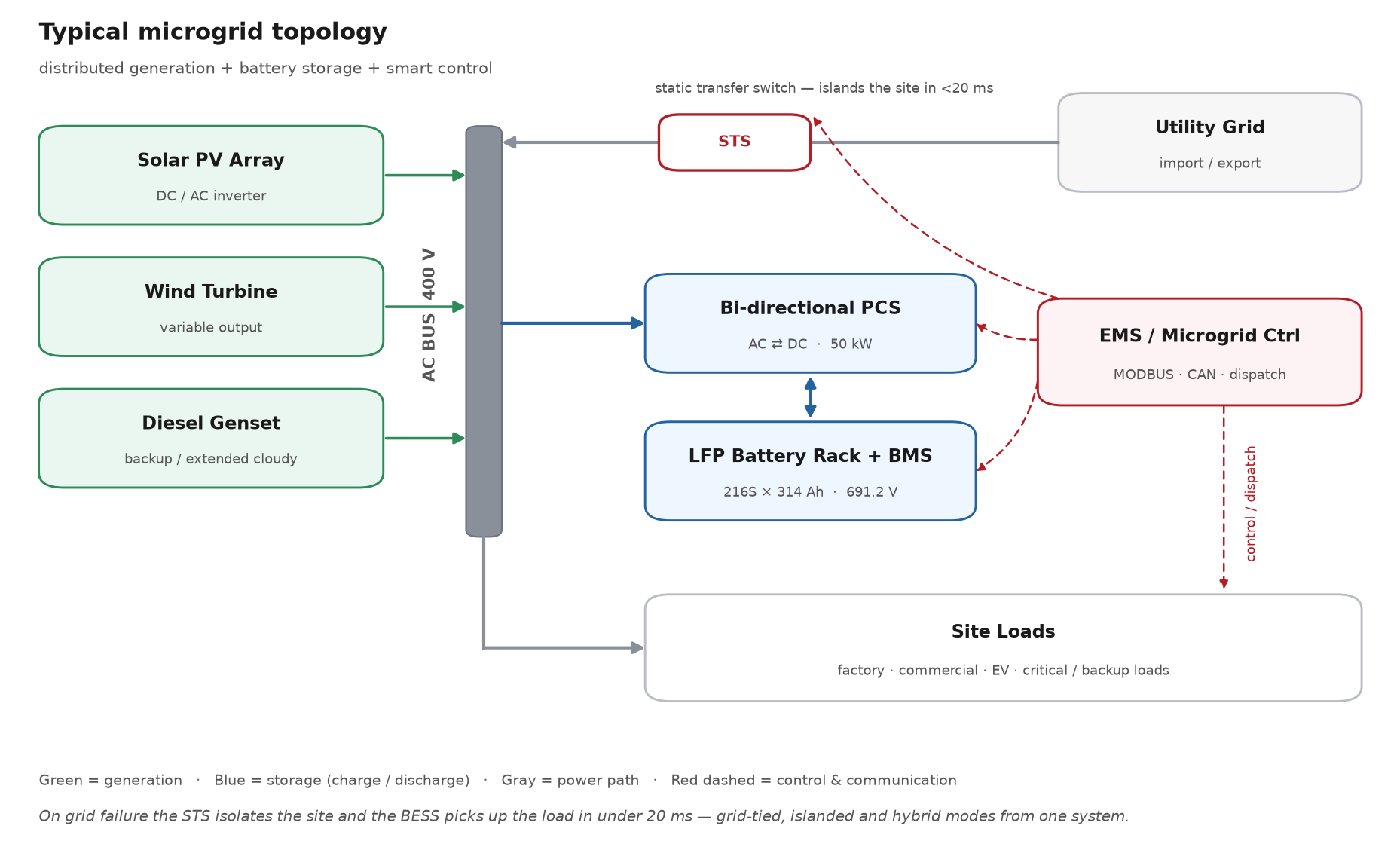
Typical microgrid topology: distributed generation + BESS + smart controller serving local loads (grid-tied, islanded and hybrid operation from one system)
Why BESS Is the Heart of Every Microgrid
Renewables are variable — the sun does not shine at night and wind is intermittent. Without storage, a microgrid cannot guarantee stable power. A BESS solves three fundamental problems:
- Time-Shifting Energy: Stores surplus solar at midday and releases it during evening peak, maximizing self-consumption and cutting grid draw.
- Frequency & Voltage Support: Responds in milliseconds to smooth fluctuations from variable generation, keeping the microgrid stable.
- Seamless Islanding: When the main grid fails, the BESS disconnects and carries the load within milliseconds — customers never notice the outage.
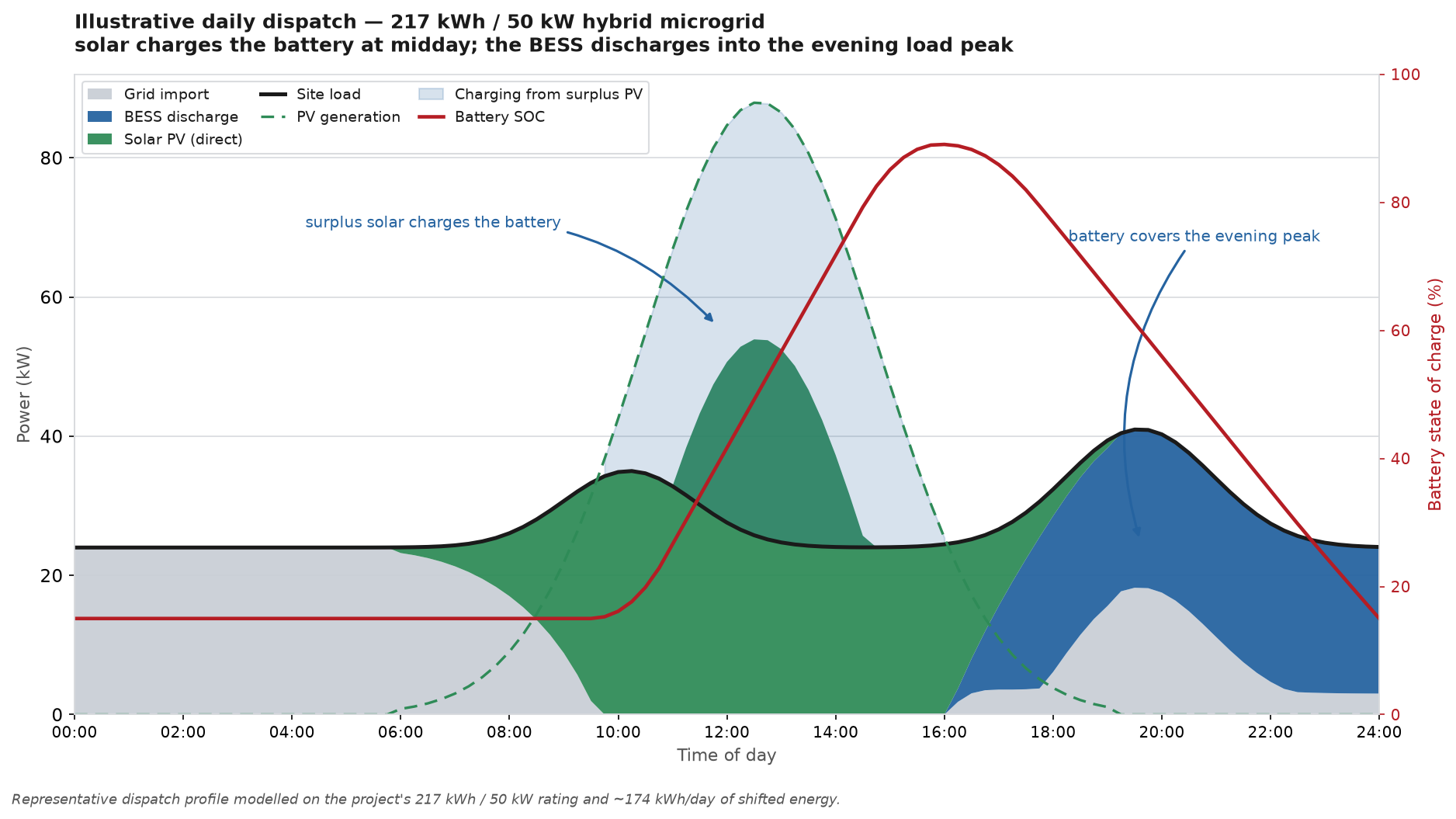
Typical daily energy flow in a hybrid microgrid: midday solar surplus charges the battery, which then covers the evening load peak (illustrative)
TAOYAN’s Storage Portfolio for Microgrids
From wall-mounted 5–30 kWh residential units to cabinet-type 100–3,000+ kWh C&I systems and containerized MWh-scale solutions, TAOYAN provides the LFP battery backbone for microgrids of every size. All integrate with standard PCS and EMS protocols (MODBUS / CAN), so they drop into existing microgrid controllers without custom engineering. Learn more in our C&I energy storage overview.
Microgrid in Action: A Real TAOYAN Project
Industrial Microgrid — Taoyuan 1.72 MWh Project, Taiwan, China
At a wastewater treatment plant in Taoyuan, Taiwan, China, TAOYAN deployed a 1.72 MWh (1,720 kWh) air-cooled LFP BESS with an 800 kW grid-tied inverter as the storage core of the site’s microgrid. The system lets the facility capture and shift energy on its own terms — cutting exposure to peak tariffs and giving the plant a resilient, self-sufficient power backbone. In the plant manager’s own words:
“Since we installed this system, it earns money for us every single day — even when we’re not doing a thing.”
— Plant Manager, Taoyuan 1.72 MWh BESS project, Taiwan, China
Project Snapshot
| Item | Detail |
|---|---|
| Location | Wastewater treatment plant, Taoyuan, Taiwan, China |
| Application | Industrial microgrid — energy shifting & resilience |
| System size | 1.72 MWh (1,720 kWh) BESS |
| Battery & cooling | LFP, air-cooled |
| Inverter | 800 kW grid-tied |
| Commissioned | July 2025 |
TAOYAN deployed a 1.72 MWh (1,720 kWh) air-cooled LFP BESS with an 800 kW grid-tied inverter for the microgrid at a wastewater treatment plant in Taoyuan, Taiwan, China, commissioned in July 2025, delivering on-site energy shifting and backup resilience. According to the plant manager, the system “earns money for us every single day.”
Grid-Tied, Off-Grid, and Hybrid Microgrids
| Type | Connection | Best For | BESS Role |
|---|---|---|---|
| Grid-Tied | Connected, exports/imports | Factories, commercial parks | Peak shaving, arbitrage, backup |
| Off-Grid | No utility connection | Remote villages, islands, mines | Primary supply + renewable buffering |
| Hybrid | Switches automatically | Critical facilities, campuses | Seamless islanding on outage |
For a deeper look at how storage handles daily load peaks in grid-tied systems, see our guide on peak shaving and load shifting, and how solar + storage integration works end to end. Choosing between a cabinet and a container for your microgrid? Compare them in container vs cabinet BESS.
Where Microgrids Deliver the Most Value
Frequently Asked Questions
What size BESS do I need for a microgrid?
It depends on your loads, renewable capacity, and whether you need backup. A rule of thumb: size storage for 2–4 hours of critical load, then scale for self-consumption goals. TAOYAN engineers model this during project scoping.
Can a microgrid run entirely on batteries and solar?
Yes — off-grid microgrids do exactly this, often with a diesel or generator backup for extended cloudy periods. The BESS carries the base load while solar charges it by day.
How fast does a microgrid switch to island mode?
With a BESS-based controller, the transition is typically under 20 milliseconds — fast enough that sensitive equipment keeps running without interruption. TAOYAN’s microgrid-ready BESS supports sub-20 ms transfer through integrated transfer-switch modules, keeping critical loads running through a grid failure with no downtime.
What kind of results do TAOYAN microgrid BESS deliver?
At a wastewater treatment plant in Taoyuan, Taiwan, China, TAOYAN deployed a 1.72 MWh (1,720 kWh) air-cooled LFP BESS with an 800 kW grid-tied inverter — in operation since July 2025. In the plant manager’s words, the system “earns money for us every single day — even when we’re not doing a thing.” Beyond the headline, a well-designed microgrid turns volatile energy costs into predictable, self-generated value: peak tariffs shrink, backup resilience is built in, and the facility gains control over its own power.
Does TAOYAN provide the full microgrid or just batteries?
TAOYAN supplies the BESS core (LFP battery, PCS, BMS, EMS) and integrates with your chosen solar/wind and microgrid controller. We support OEM/ODM configurations for EPCs and developers.
Build Your Microgrid Storage Backbone with TAOYAN
From residential units to MWh container systems — tell us your load profile and we’ll size the right LFP BESS.
Contact Our Team →