
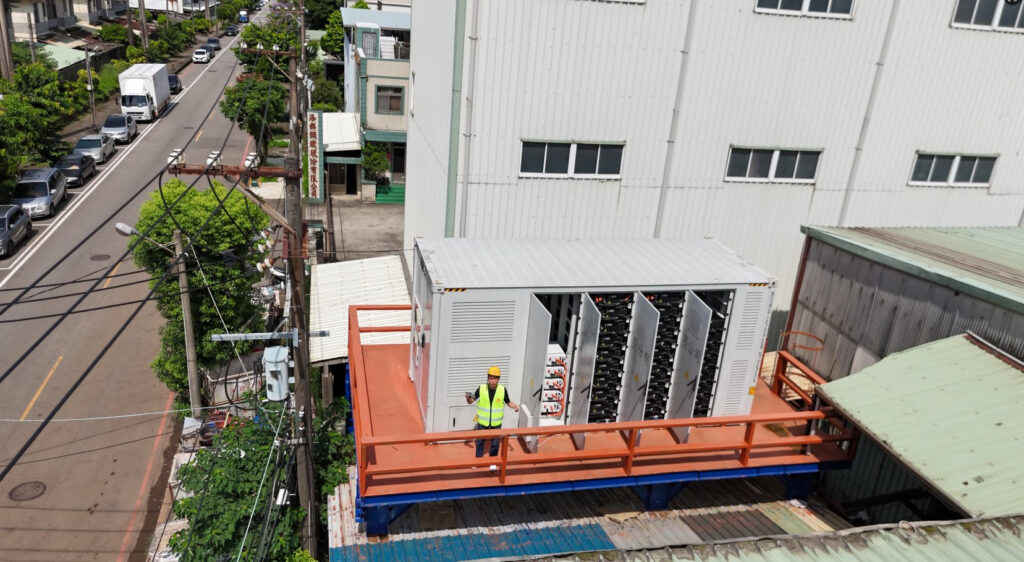
Do You Need Grid-Forming BESS? 6 Checks to Decide
Grid-forming storage is being pitched as a blanket upgrade — as if every battery site should be “grid-forming” and anything else is outdated. It is neither free nor universal. Grid-forming (virtual synchronous generator, or VSM/VSG) control changes how the converter behaves: instead of following an existing grid voltage, it can establish and hold voltage and frequency itself. That capability is essential on some sites and unnecessary expense on others. The decision should come from six engineering and commercial checks, not from a product label.
This is a decision guide, not a control-theory lesson. If you want the mechanism first, our wider library covers how VSG control keeps a weak grid stable and what a grid-forming plant looks like in the field; here we stay with the question that comes before specification: does my project actually need it? If you are still sizing the converter, start with how to size a PCS for a commercial BESS — grid-forming is a mode decision that sits on top of the power rating.
Work through the six checks below. If most answer “no”, a well-specified grid-following system is very likely enough, and paying for grid-forming hardware and commissioning you cannot use is wasted capital. If several answer “yes”, treat grid-forming as a requirement and write it into the technical agreement with test evidence attached.
Key conclusions
- It is a mode, not a badge: grid-forming means the converter can set voltage and frequency; grid-following synchronises to an existing grid. Different controls, different tests, different cost
- Grid strength is the first question: a weak grid (low short-circuit ratio) is the single strongest technical signal that following control will struggle
- Islanding and black start are hard requirements: if the site must run without the utility or restart a dead network, following control cannot do it at all
- Inertia and grid code are tightening: low-inertia networks and new connection rules increasingly demand voltage and frequency support that only forming control provides
- Do not pay for unused capability: a peak-shaving site on a strong grid rarely needs grid-forming; buy it only when a check genuinely points there
1. How strong is the grid at the connection point?
This is the first check because it decides whether the question is even optional. Grid strength is usually expressed as the short-circuit ratio (SCR) at the point of connection — roughly the grid’s fault level divided by the plant’s rated power. A strong grid has a high SCR and holds its voltage and frequency even when the BESS injects or absorbs heavily. A weak grid has a low SCR: the voltage moves when you push power into it, and a grid-following converter that needs a stable voltage to synchronise to starts hunting, tripping or derating.
Ask the network operator for the fault level at the connection point and calculate SCR for your plant rating. As a rough guide, an SCR below about 3 is where following control begins to need careful study, and below about 2 it becomes a serious problem. Long rural feeders, remote industrial parks and weak interconnects are the typical candidates. If this number is low, the remaining checks are largely confirmation — start planning for grid-forming.
2. Must the site run as an island or off-grid?
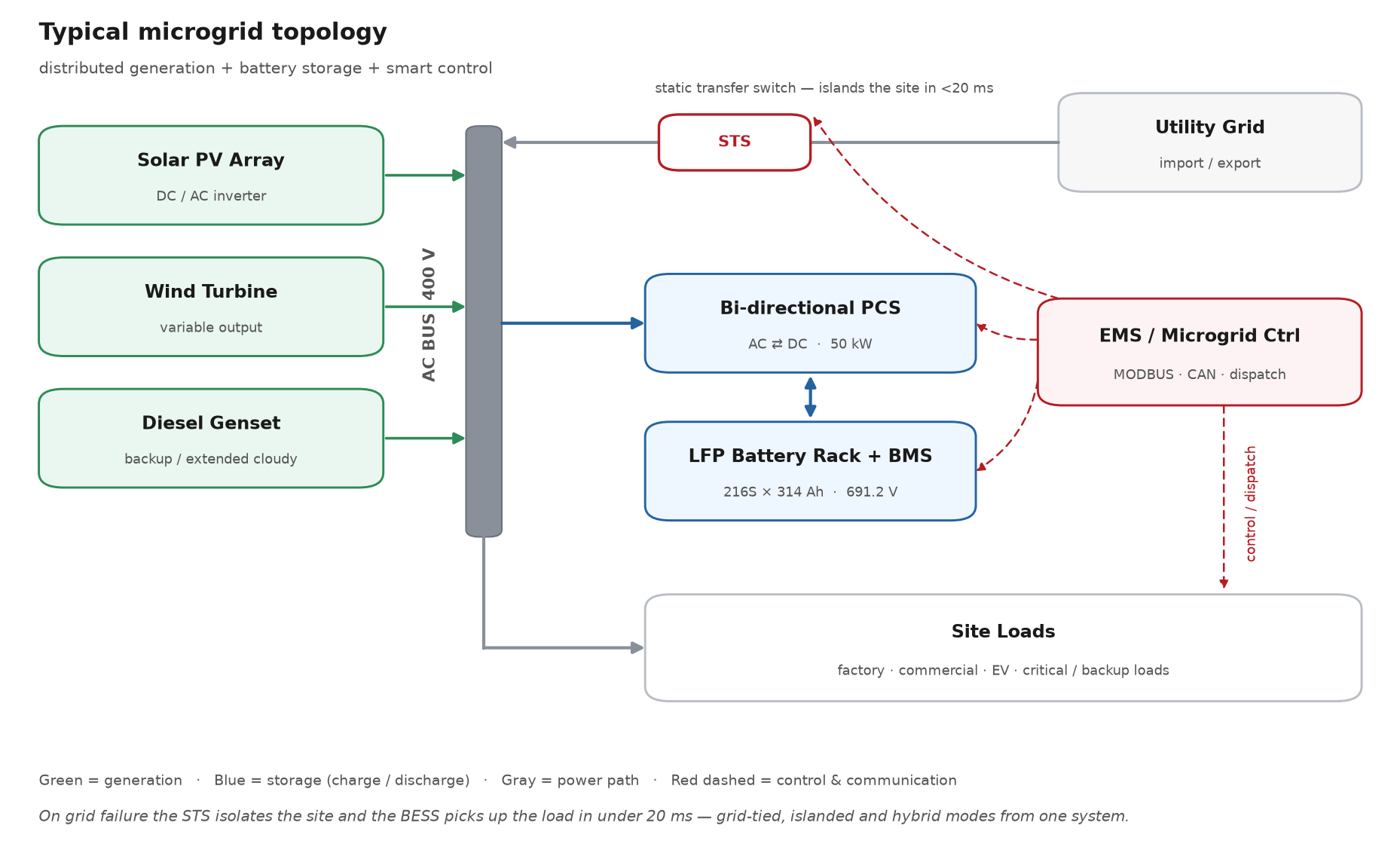
A grid-following converter needs a voltage to follow. Take the utility away and it has nothing to synchronise to, so it trips — by design. If the project must keep loads energised during an outage, operate as a microgrid, or serve a remote mine, island or construction site with no reliable utility supply, the battery plant has to create its own voltage and frequency. That is precisely what grid-forming control does.
Be specific about the duty: is islanding a rare backup mode or the normal operating state? Does the site need to transition smoothly between grid-connected and islanded without dropping critical loads? Seamless transfer and sustained island operation are the clearest “yes” answers in this whole checklist, and they should be written as testable functions rather than a marketing claim.
3. Is black start or grid restoration required?
Black start means restarting a dead network without any external supply — the battery must energise the bus, establish voltage and frequency, then bring other generation and loads back online in a controlled sequence. Only grid-forming storage can do this, because there is no live grid to follow. Transmission operators and some industrial sites contract for this service explicitly.
Check whether the connection agreement or the site’s resilience plan calls for black start, and at what scale: restoring a single isolated bus is very different from forming a network and picking up large motor loads. If black start is in scope, grid-forming is not an option. We covered the sequence and the load-pickup problem in a dedicated article on black start with battery storage.
4. How much rotating inertia is left on the network?
Conventional generators spinning in synchronism provide inertia that naturally resists frequency changes. As solar, wind and batteries displace them, system inertia falls and frequency can move faster after a disturbance. A grid-following BESS can inject active power to arrest a frequency drop, but it reacts to a measured frequency rather than behaving like a synchronous machine. Grid-forming control can present an emulated inertia — a virtual synchronous generator — and a fast, inherent frequency response.
This check matters most on islands, weak national grids and networks with high renewable penetration. Look at the system’s inertia outlook and the frequency stability studies the operator has published. If falling inertia is a documented concern and the regulator expects new resources to support frequency, grid-forming becomes a forward-looking requirement even on a site that is strong today.
5. What does the grid code actually require?
Connection rules are changing faster than most equipment specifications. A growing number of jurisdictions are writing explicit requirements for fast voltage support, synthetic inertia, and grid-forming or “grid-supporting” behaviour into their grid codes — especially for large plants and newly interconnecting storage. What was optional two years ago may now be a condition of connection or of participation in an ancillary-service market.
Do not rely on a generic statement of compliance. Obtain the applicable grid code version, identify the exact clauses on voltage, frequency and forming behaviour, and ask for type-test reports from an accredited laboratory against those clauses. A converter that cannot document ride-through, reactive support and voltage/frequency formation will fail acceptance regardless of its headline efficiency.
6. Is there a revenue stream that pays for it?
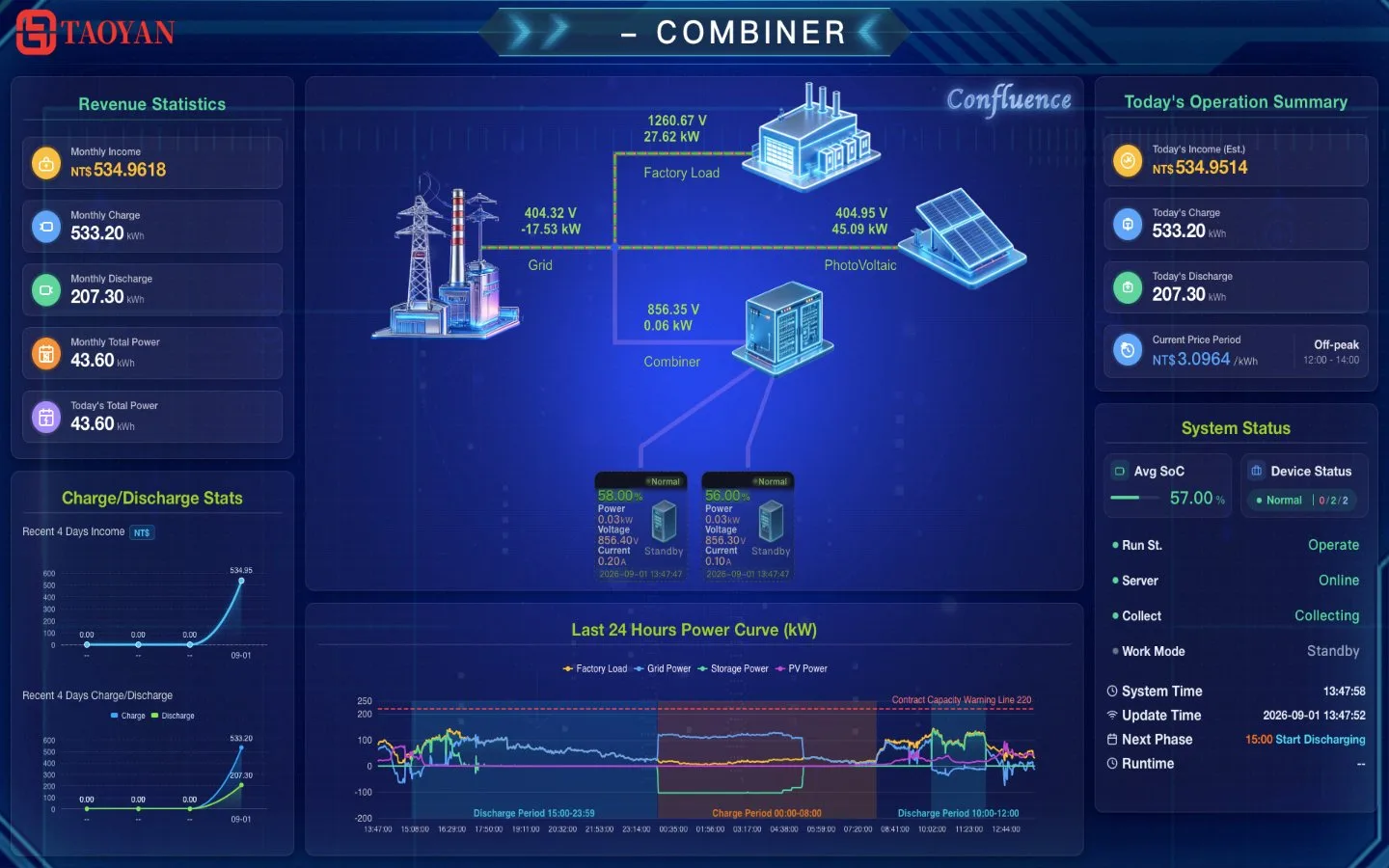
Even when the technical case is marginal, the commercial case can decide it. Some markets now pay for fast frequency response, synthetic inertia, voltage support and black-start capability — services a grid-following plant simply cannot sell. If those revenue lines exist at your site, grid-forming can be the feature that makes the project bankable rather than a cost to justify.
Price both sides honestly. Grid-forming capability adds cost in converter hardware, in the control and protection design, and in commissioning and testing; it may also require a larger battery reserve to sustain support. Weigh that against the services it unlocks and against the penalty or curtailment risk it avoids on a weak or constrained network. Where no such revenue or risk exists, the extra capability has no payback.
7. The six checks at a glance
Use this table as a first pass with your EPC and the network operator. It does not replace studies, but it tells you which studies to commission.
| Check | Signal that points to grid-forming | What to verify |
|---|---|---|
| 1 · Grid strength | Low SCR (roughly below 3), weak or long feeder | Fault level at the connection point; stability study |
| 2 · Islanding | Must run without the utility, microgrid or remote site | Seamless transfer and sustained island operation test |
| 3 · Black start | Must restart a dead bus or network | Black-start sequence and motor load-pickup evidence |
| 4 · Inertia | Falling system inertia, high renewable share | Operator inertia outlook; frequency stability study |
| 5 · Grid code | Clauses requiring forming behaviour or fast support | Applicable code version; accredited type-test reports |
| 6 · Revenue | Payment for FFR, inertia, voltage or black start | Market rules; tariff for each ancillary service |
8. Grid-following vs grid-forming, side by side
The two modes are not a hierarchy where one is simply better. They solve different problems, and a single plant can even be specified to operate in both. What matters is buying the capability the site will actually use.
| Aspect | Grid-following | Grid-forming |
|---|---|---|
| Voltage / frequency | Synchronises to the existing grid | Establishes and holds them itself |
| Weak grids | Struggles at low SCR | Designed for weak and low-inertia networks |
| Island / black start | Cannot operate without a live grid | Can island and restart a dead network |
| Inertia support | Reactive fast active-power injection | Emulated inertia and inherent frequency response |
| Cost and testing | Lower; standard commissioning | Higher; forming and transfer tests required |
| Best fit | Peak shaving, demand charge, backup on strong grids | Weak grids, microgrids, critical resilience, new markets |
9. How TAOYAN approaches the decision
TAOYAN is a C&I energy storage system integrator based in Dongguan, China. We purchase LFP cells, assemble cabinets and containers on our own integration lines, and develop the BMS and EMS firmware in-house. We do not run a cell production line and do not claim to. Our job at this stage is to help an owner answer the six checks honestly, then match PCS, battery clusters, thermal design and control firmware to the answer — including whether grid-forming is warranted at all.
Part of that honesty is knowing what we cannot change. The approved connection capacity, the grid code version, the fault level the operator will actually provide and the local market rules sit outside an integrator’s control. They are inputs to the decision, not things a supplier can promise away. A grid-forming claim is only as good as the accredited type-test reports and the site studies behind it.
We publish this and our other engineering notes in English, Simplified Chinese and Traditional Chinese because on cross-border projects the EPC, the owner and the commissioning team rarely read the same language; a capability that shifts in translation is a capability that gets specified wrong. The controlled parameters on our 2610 kWh / 1250 kW product page match its datasheet and its grid-code documentation. If a downloaded file and the web page disagree, ask for the revision number before continuing the design.
常见问题
What is the fundamental difference between grid-following and grid-forming?
A grid-following converter synchronises to a voltage and frequency that already exist on the grid; it injects current in phase with that grid. A grid-forming converter establishes and holds voltage and frequency itself, behaving more like a synchronous machine. That is why only forming control can run an island or restart a dead network — there is no grid to follow in either case.
What is SCR, and what counts as a weak grid?
SCR, the short-circuit ratio, is roughly the grid’s fault power at the connection point divided by the plant’s rated power. A high SCR means a stiff grid that holds voltage well; a low SCR means a weak one. As a rough guide, below about 3 following control needs careful study and below about 2 it becomes a serious problem. Get the fault level from the network operator and calculate it for your rating — do not guess from the distance to the substation.
Does my commercial peak-shaving project need grid-forming?
Usually not. A peak-shaving or demand-charge site connected to a strong grid is well served by a properly specified grid-following PCS, and grid-forming hardware and testing would add cost with no payback. Run the six checks: if grid strength is high and there is no islanding, black start, inertia or forming requirement in the code or market, stay with following control.
Can grid-forming and grid-following units run in parallel?
They can, and mixed plants exist, but it is a coordinated design rather than a plug-together exercise. Interactions between forming and following controls, and between multiple forming units, must be studied and tested — including how they share power and how they behave during faults and mode transfers. Ask the supplier for the coordination study and test evidence, not just a statement that the modes are “compatible”.
Can grid-forming be added later as a software upgrade?
Sometimes partly, often not. Forming capability depends on the converter’s control hardware, sensing, protection scheme and the plant’s overall design, and it changes the commissioning and test scope. Treat any “software-only upgrade” claim as something to verify in writing against the specific hardware and the accredited type-test report, not as a default assumption in the purchase price.
Is grid-forming required for black start?
Yes. Black start means energising a network with no external supply, so the storage must create voltage and frequency before any load is picked up — exactly what following control cannot do. The scope still matters: forming a single bus and restoring a large network with motor loads are very different duties, and both the control design and the test evidence should match the one you actually need.
How much more does grid-forming cost?
There is no honest universal percentage. The extra cost sits in converter hardware and controls, in protection and coordination design, in commissioning and accredited testing, and sometimes in a larger battery reserve to sustain support. Whether that is justified depends entirely on checks five and six: if the grid code requires it or a market pays for the services, it can be worth it; if neither does, it is cost without return.
How do I write grid-forming capability into a technical agreement?
Write functions and evidence, not adjectives. State the required behaviours — voltage and frequency formation, emulated inertia, fault ride-through, seamless island transfer, black start if needed — with the performance values and durations, then require accredited laboratory type-test reports against the applicable grid code clauses. Tie each line to the single-line diagram and to the site studies so the capability can be verified at acceptance.