
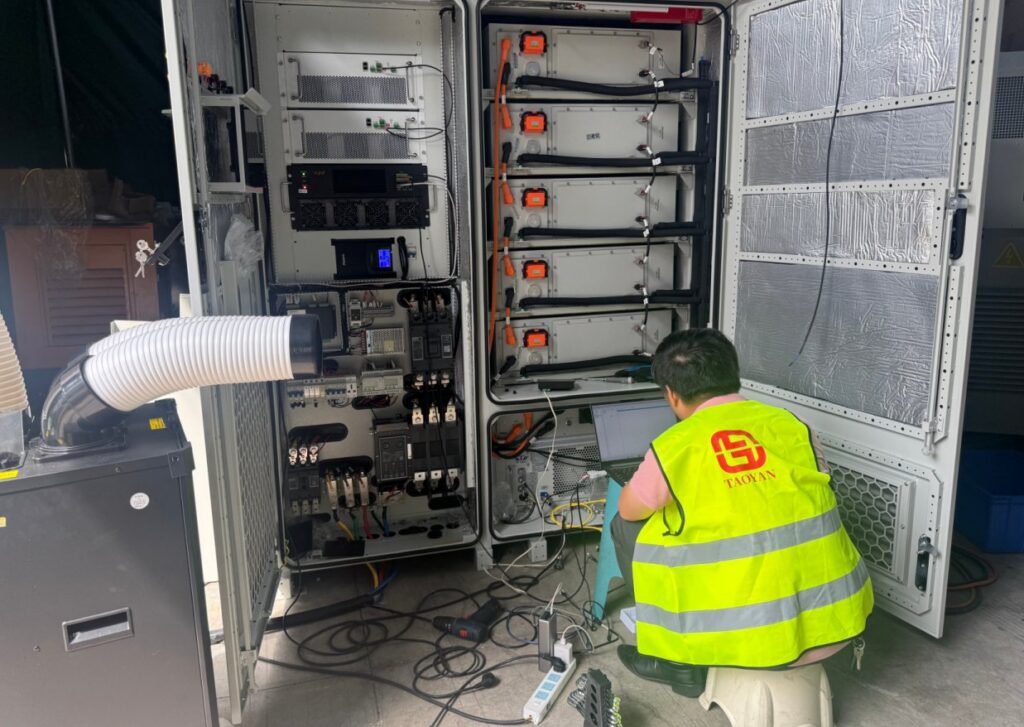
How to Size a PCS for a Commercial BESS: 6 Checks That Decide the Power Rating
Two quotes for the same 2610 kWh container can differ by a wide margin. One sizes the PCS at 1250 kW, the other at 630 kW. Neither supplier is necessarily wrong — they simply assumed different jobs for the system. The power conversion system (PCS) is the part that turns the battery’s DC energy into grid-ready AC power, and its rating is where much of the engineering and much of the cost concentrate.
We covered how to derive kW and kWh from a load profile and, more recently, how to read a BESS datasheet line by line. This article picks up at the next decision: turning a calculated power target into a PCS specification you can put into an RFQ. If you already know the main categories of PCS, this is the sizing companion to that overview. It is written for EPCs, developers and factory owners who must sign a technical agreement before ordering.
The example below uses a controlled 2610 kWh / 1250 kW liquid-cooled grid-connected system, but the six checks apply to anything from a 100 kW cabinet to a multi-MWh site.
Key conclusions
- Power and energy are two different decisions: PCS kW sets how fast the system can charge or discharge; battery kWh sets how long it can keep doing so. Fix the duration before you fix the kW
- The DC voltage window matters more than the nominal voltage: an 832 V nominal pack only means something alongside its 748–915 V operating window; a narrow window cannot deliver full power at low state of charge
- Rated and peak power are separate promises: put continuous output in the contract, short-duration capability in a separate capability table, with duration and ambient conditions attached
- Grid behaviour can stop commissioning: ride-through, reactive support and harmonics must be checked against the local grid code — efficiency will not rescue a non-compliant PCS
- 400 V or 690 V is a system decision: dual-voltage configurability changes the step-up transformer, switchgear and cable schedule, not just one line of the datasheet
1. Power rating is a duty decision, not a size contest
The most common sizing mistake is to treat the PCS as an accessory to the battery — pick the energy you need, then buy a converter that “fits”. That inverts the problem. The PCS determines which services the plant can perform at all: how much peak demand it can shave in a single interval, how much reserve it can inject in the first seconds after a disturbance, and how quickly it can absorb a production spike from a variable load.
For a 2610 kWh pack, a 1250 kW PCS is roughly a 0.48C system — about two hours of full-power discharge. A 630 kW PCS is about 0.24C, a four-hour system. Both are legitimate. They simply serve different tariffs and different load shapes. Over-sizing wastes capital and pushes operation into the low-efficiency region of the converter curve; under-sizing leaves the battery’s energy stranded behind a power bottleneck. The right rating comes from the duty, so start there.
2. Three load targets, three sizing calculations
“Size the PCS from the load profile” is good advice but incomplete, because the calculation depends on what you are trying to achieve. Peak shaving follows the height of the peaks above a threshold; demand-charge management follows the billing interval; backup follows the critical load that must be carried. These three targets routinely produce different power ratings on the same site.
| Target | What sets the kW | What sets the kWh | Typical risk |
|---|---|---|---|
| Peak shaving | Highest sustained interval above the cap | Sum of energy above the cap over the event | Undersizing clips the peak you billed for |
| Demand-charge management | Billing-window average, not the instantaneous spike | Energy across the whole billing window | Designing to the spike wastes power rating |
| Backup / resilience | Sum of protected critical loads, with start-up margin | Autonomy hours required at that load | Ignoring motor inrush trips the plant |
Export a 15-minute load profile for a full year before running any of these calculations. A single “design day” hides the 20 or 30 days that actually determine the rating, and those are the days the owner will remember when the system fails to cap a charge. If you need the underlying method, the kW/kWh sizing guide works through the four numbers to extract from the profile.
3. Match the DC voltage window to the battery cluster
A PCS is specified with a DC input voltage range. A battery is specified with a nominal voltage and an operating window across its full state-of-charge span. These two ranges must overlap across the entire usable SOC — not just at the nominal point. In the example system, the pack is 832 V nominal with a 748–915 V operating window. If the PCS only delivers full AC power above 780 V DC, the last part of the discharge becomes power-limited exactly when the site needs it.
Ask for the PCS full-power DC range and the derating curve below it, in writing. A datasheet that quotes only a “wide voltage range” without saying where full power ends is not a specification you can design against. Check the same range against the coldest expected cell temperature too: a lithium pack’s voltage sags under load in the cold, which can push the operating point below the PCS window sooner than the SOC alone suggests.
4. Rated power, peak power and how long each holds
Rated power is the continuous output guaranteed under stated conditions of ambient temperature and altitude. Peak power is a short-duration capability. The two belong in different parts of a contract. A 1250 kW rated / 1300 kW peak PCS can cover a brief inrush, but it cannot hold 1300 kW through a four-hour evening peak — and a contract written against the peak figure will describe a plant that cannot deliver what the owner expects.
Attach three conditions to every power number: the ambient temperature and altitude at which it is guaranteed, the duration for which a peak can be held, and the recovery interval between peaks. Cooling method determines how quickly the converter can sustain rated output on a hot afternoon; the liquid-versus-air cooling comparison explains why that line matters more than a headline efficiency figure.
5. Overload capability and motor-start inrush
Industrial sites are full of motors. A direct-on-line start can draw several times its running current for a fraction of a second, and a BESS used for backup or peak shaving will see that transient. If the PCS has no defined overload envelope, the first large motor start can trip the whole system — or force the owner to oversize the converter just to cover a half-second event.
Specify overload as a curve, not a single number: for example 110% for 60 seconds, 150% for 10 seconds, with the ambient conditions stated. Confirm that the battery can actually supply the corresponding DC current at the required SOC and temperature, because a converter’s overload is useless if the pack sags out of its window the moment it is asked for more.
6. Grid behaviour: grid-following, grid-forming and ride-through
Most commercial BESS plants operate grid-following: the PCS synchronises to an existing grid voltage. A grid-forming PCS can establish and hold voltage and frequency, which matters for weak grids, islandable sites and microgrids. These are different control modes with different equipment and different commissioning tests — not a software option you can assume is included.
Then check the grid code item by item: low- and high-voltage ride-through, frequency ride-through, reactive power support, ramp rate, harmonics and DC injection. A converter with excellent efficiency but no certified ride-through will fail acceptance in most jurisdictions. Ask for type-test certificates from an accredited lab, not a supplier statement.
7. The PCS checklist to put in your RFQ
Turn the six checks above into required answers rather than marketing claims. Require one response per line and ask that any figure be tied to stated ambient and altitude conditions. This makes otherwise incomparable quotes comparable and gives the electrical designer a document to work from.
| # | Item to specify | What a good answer contains | Red flag |
|---|---|---|---|
| 1 | Duty and duration | Target service,kW and required hours stated together | A kW figure with no duration |
| 2 | Full-power DC range | Covers the pack’s entire usable window, with derating curve | “Wide range” with no full-power point |
| 3 | Rated vs peak power | Separate values, duration and recovery stated | Contract written against peak |
| 4 | Overload envelope | Curve with time limits and ambient conditions | Single unqualified overload number |
| 5 | Grid mode and code | Following/forming declared; accredited type-test certificates | “Compliant” with no certificate |
| 6 | Efficiency and losses | Euro/CEC weighted efficiency plus standby draw | Peak efficiency only |
| 7 | AC voltage and transformer | 400 V / 690 V options with step-up scheme | Voltage changed without redesign |
| 8 | Cooling and derating | Method plus altitude/temperature derating curve | Rated only at 25 °C, sea level |
8. How TAOYAN specifies a PCS
TAOYAN is a C&I energy storage system integrator based in Dongguan, China. We purchase LFP cells, assemble cabinets and containers on our own integration lines, and develop the BMS and EMS firmware in-house. We do not run a cell production line and do not claim to. What we control is the matching between PCS, battery clusters, thermal design and control firmware, together with the factory acceptance testing behind it — a PCS specification is one of the written outputs of that work.
That is also why we publish the same specification in English, Simplified Chinese and Traditional Chinese. On a cross-border project the EPC, the owner and the commissioning team rarely read the same language; a parameter that shifts in translation is a parameter installed wrong. The controlled values on our 2610 kWh / 1250 kW product page match its datasheet PDF. If a downloaded file and the web page disagree, ask for the revision number before continuing the design.
We are equally clear about what an integrator cannot change: the approved grid connection capacity, transformer upgrades and local tariff rules sit outside our scope. They belong at the front of every proposal as hard constraints. A PCS specification describes the equipment we can guarantee, not the connection the grid operator chooses to grant.
常见问题
What is the difference between PCS power (kW) and battery capacity (kWh)?
kW is the rate at which the PCS can move energy in or out; kWh is how much energy the battery stores. A 2610 kWh pack with a 1250 kW PCS discharges at roughly 0.48C and lasts about two hours at full power. The same pack with a 630 kW PCS lasts about four hours. Size the duration from the load first, then derive the kW — not the other way around.
Why does the DC voltage window matter more than the nominal voltage?
Because the battery only sits at its nominal voltage for part of the discharge. A pack might be 832 V nominal but operate between 748 V and 915 V across its usable state of charge. If the PCS can only produce full AC power above 780 V DC, the final part of the discharge is power-limited. Always request the full-power DC range and the derating curve below it, and check both at low temperature.
Should the contract specify rated power or peak power?
Guarantee continuous rated power in the contract. Record peak power separately with its duration, ambient conditions and recovery interval. A peak figure describes a short overload capability, not what the plant can deliver through a multi-hour peak, and a contract written against it will not describe the system the owner actually receives.
How much overload capability does a PCS need?
Enough to cover the largest expected motor start or load step without tripping, specified as a time-limited curve rather than a single number — for example 110% for 60 seconds and 150% for 10 seconds at a stated ambient temperature. Confirm that the battery can supply the required DC current at that state of charge and temperature, otherwise the converter’s overload rating cannot be used.
What is the difference between grid-following and grid-forming PCS?
Grid-following converters synchronise to an existing grid voltage and are the norm for commercial BESS. Grid-forming converters can establish and hold voltage and frequency, which is needed on weak grids, islandable sites and microgrids. They are different control modes with different equipment and commissioning tests; declare which one the quote includes rather than assuming it is a software option.
Is a 98% peak efficiency much better than 99%?
Barely, and the headline number is often the least useful one. What affects the business case is weighted efficiency across real operating points and standby consumption during idle hours. Ask for Euro or CEC weighted efficiency and the no-load draw, then compare those against the cooling losses at your site’s ambient temperature.
Should I choose 400 V or 690 V AC output?
It depends on the plant’s step-up scheme and the approved connection. Many systems are offered as dual-voltage configurable — 400 V or 690 V AC optional or dual-adaptable — so the choice should be made together with the transformer, switchgear and cable design rather than treated as a lone datasheet line. Once the voltage is fixed, the single-line diagram and the technical agreement must be updated together.
What documents should I request alongside the PCS datasheet?
At minimum: the full-power DC range with derating curve, the grid-code type-test certificates, the overload envelope, the efficiency curve and standby draw, the cooling and altitude derating notes, and a controlled revision number and date. Match each against the single-line diagram. If the downloaded datasheet and the web page disagree, request the revision before using either for design.