
How to Read a Grid-Connected BESS Datasheet: 10 Specifications That Decide What You Actually Buy
A datasheet is the shortest document in a storage procurement, and the one most often read too quickly. Two suppliers send PDFs that both say 2610 kWh. The buyer compares the price per kWh, chooses the lower one, and discovers at commissioning that one figure is DC nameplate capacity for a new battery while the other is AC-side guaranteed output at year ten. The two systems were never comparable.
In our previous note we covered how to size kW and kWh from the load curve. That calculation produces a requirement. This guide covers the next step: field by field, how to check whether a supplier’s specification sheet actually describes that requirement, and which of its numbers belong in the signed technical agreement rather than in a sales deck.
We use the controlled revision of a 2610 kWh / 1250 kW liquid-cooled grid-connected system as the worked example, because almost every value in it can be reconstructed from the cell and module data. The same ten checks apply to any grid-connected C&I BESS. They are written for EPC contractors, developers and industrial buyers who have to approve a specification before a purchase order is issued.
Key Facts
- The model number is a unit test:
TY-2610kWh-1250kWcarries energy in kWh and power in kW. A model that reads...kW-BESSwith no kWh has conflated the two, and should be queried before any other number is discussed 10P260Sis a circuit description, not a part number: ten parallel strings, each of 260 cells in series. With 314Ah cells it reconstructs 832V nominal and roughly 2610kWh of DC nameplate capacity- Three voltages live on three different sides: 832V nominal DC, a 748–915V DC operating window, and 400V AC at the PCS. Quoting one as another is the fastest route to the wrong transformer and the wrong cable schedule
- Rated 1250kW and maximum 1300kW are not the same promise: continuous output belongs in the contract; short-term overload belongs in the capability table, with its duration and ambient conditions stated
- A
/in the PV and MPPT rows is information, not a missing cell: it declares a pure grid-connected topology with no PV input stage. Numbers in those three rows describe a hybrid machine and a different single-line diagram - Dimensions and weight are engineering constraints, not footnotes: 6050 × 2438 × 2400 mm and 25T decide the foundation, crane capacity, transport permits and site access long before the container arrives
1. Start With the Model Number and the Configuration
Read the model line first because it is the only place where the supplier states, in one string, what the system claims to be. A grid-connected container is an energy-and-power pair: TY-2610kWh-1250kW says 2610 kWh of DC capacity behind a 1250 kW AC converter. If the kWh is missing, or the two units are swapped, the rest of the sheet may still be internally consistent while describing a different product class. Ask for the controlled revision before comparing anything else.
Then check that the configuration can be rebuilt from the cell data. The example sheet states LFP-314Ah cells, 10P260S, an 832V nominal voltage, and a 1P52S / 166.4V / 52.25kWh module. The arithmetic closes: a 3.2V 314Ah cell stores about 1004.8Wh; 52 in series give 166.4V and 52.25kWh per module; five modules in series give 260S, 832V and 261.25kWh per string; ten strings in parallel give 10P260S and about 2612kWh, which is the 2610kWh nameplate after rounding. That is a specification you can audit.
If the configuration cannot be reconstructed this way, treat every downstream number as unverified. A sheet that states a capacity and a voltage but no string or module topology gives you nothing to check the capacity against, and no basis for a spare-parts list. The distinction between DC nameplate and AC deliverable energy is the subject of our kW and kWh sizing guide; here the point is simply that the DC figure must be traceable to cells.
2. Three Voltages That Are Not Interchangeable
The voltage column is where otherwise careful comparisons go wrong. A battery system has a DC side, a PCS DC input, and an AC grid side; each carries its own voltage and its own design consequences.
| Field | Example value | Which side | What it decides |
|---|---|---|---|
| Nominal DC voltage | 832V | Battery string | Insulation coordination, BMS sampling, DC cabling and protection |
| DC operating window | 748–915V | Battery across SOC | PCS DC input range, usable SOC window, whether full power holds at low charge |
| Rated AC voltage | 400V, 50/60Hz | PCS grid side | Step-up transformer, switchgear, cable sizing, interconnection study |
A 400V AC output normally means the container connects through a step-up transformer to the site’s medium-voltage network. That transformer is a real cost, a real footprint and a real loss term; it is not visible anywhere in the kWh figure. Confirm it in the single-line diagram. We go into the converter-side trade-offs in our PCS selection guide.
One more discipline matters more than any single value: if the datasheet, an FAQ, a brochure and the single-line diagram disagree on voltage, the controlled revision of the datasheet and the signed technical agreement govern. Version drift inside a supplier’s own document set is common, and it is exactly what a pre-order specification review is supposed to catch.
3. Rated Power, Maximum Power and the Derates Behind Them
The example sheet lists 1250kW AC rated output and 1300kW AC maximum output. Rated means continuous under stated conditions; maximum means a short-term capability, useful for motor starts and transient load steps. A contract written against the maximum figure will not describe what the plant delivers through a four-hour summer peak.
Ask three questions of every power figure. At what ambient temperature and altitude is it guaranteed? For how long can the maximum be held, and with what recovery interval? Which losses are already deducted? Liquid cooling units, the EMS, fire suppression and site auxiliaries draw from the same meter, and high ambient temperature or high altitude reduces output even when the battery itself is healthy. Our liquid versus air cooling comparison covers the thermal part of that derating; the cost and ROI model shows where it lands in the revenue case.
Then connect the power figure back to the four derates that separate DC nameplate from AC deliverable energy — depth of discharge, round-trip efficiency, auxiliary consumption and end-of-life retention. A datasheet that quotes only one kWh number, with no year of life and no AC-side guarantee, has not yet given you a quantity you can put into a business case.
4. Why Three Rows of “/” Matter More Than They Look
On a pure grid-connected specification, the maximum PV input voltage, MPPT operating voltage range and MPPT full-load voltage range rows are marked /. That is a topology statement: there is no PV input stage, no DC/DC charger and no MPPT controller inside this system. The battery charges from the grid through the bidirectional PCS.
If those rows instead carry values such as 1000V PV input and 250–850V MPPT ranges, you are looking at a hybrid machine designed to accept a PV array on the DC side. The two are not interchangeable variants of one product. They imply different single-line diagrams, different EMS charge-source logic, different protection and fire zoning, and often a different interconnection approval path. We have seen hybrid parameters carried over into a grid-connected datasheet during a document revision: the capacity and voltage columns stayed correct, but the PV rows told a buyer to plan for an array that was never going to be connected.
For solar-plus-storage projects the PV interface is a legitimate requirement, and our solar plus storage note covers that configuration. The check here is simpler: the PV/MPPT rows must agree with the single-line diagram, and a / must never be read as “value to be confirmed later”.
5. Physical and Environmental Fields That Decide the Site
The lower half of a datasheet is where civil, logistics and commissioning costs hide. On the example sheet: 6050 × 2438 × 2400 mm, 25T, IP54, −25°C to 55°C, ≤4000m altitude, liquid cooling and ≥8000 cycles. None of these is a marketing number.
- Dimensions and weight set the foundation design, crane or forklift capacity, road permits, turning radius and whether the unit can be placed at all on a constrained site. A 25T container arriving at a site prepared for a 12T cabinet is a schedule problem, not a specification detail
- IP54 is a protection rating against dust and water jets, not a statement that the unit can sit unprotected in a monsoon climate or a coastal salt environment. Ask about enclosure treatment, sun shade and drainage separately
- −25°C to 55°C is an operating envelope, not a guarantee of full power across it. Liquid cooling extends the envelope, but heating at low temperature and derating at high temperature still consume energy and capacity
- ≤4000m needs an explicit derating curve above 1000–2000m, because air density affects cooling and insulation clearances
- ≥8000 cycles is only comparable when depth of discharge, temperature, C-rate and end-of-life capacity retention are stated alongside it. A bare cycle count is not a warranty
Write these five into the site survey and the technical agreement before the layout is frozen. Rectifying a foundation or a transformer rating after the container ships costs more than an extra week of specification review.
6. A Ten-Field Checklist You Can Copy Into an RFQ
| # | Field | What to verify | Red flag |
|---|---|---|---|
| 1 | Model & units | Both kWh and kW present, in that order | Unit swapped or capacity missing |
| 2 | Configuration | 10P260S reconstructible from 314Ah cells and 52.25kWh modules | Capacity stated with no module or string topology |
| 3 | DC voltage | 832V nominal plus 748–915V window | Only one voltage given, or written backwards |
| 4 | AC voltage | 400V / 50–60Hz plus transformer arrangement | AC and DC voltages mixed in one row |
| 5 | AC power | 1250kW continuous / 1300kW short-term, with duration and ambient | Contract written against the maximum figure |
| 6 | PV / MPPT rows | / on a grid-connected unit, matching the single-line diagram |
Hybrid values on a system with no PV array |
| 7 | Capacity basis | DC nameplate, AC guaranteed output for year 1 and year 10 | One kWh figure, no year and no AC side |
| 8 | Dimensions & weight | 6050 × 2438 × 2400 mm, 25T, with lifting points | “To be confirmed by project” |
| 9 | Environment | IP54, −25°C to 55°C, ≤4000m, liquid cooling, derating curves | Ratings with no derating statement |
| 10 | Cycle life | ≥8000 cycles with DOD, temperature, C-rate and retention | Bare cycle count presented as a warranty |
Use the table as an attachment to the RFQ and require one answered line per field. It costs the supplier an hour and saves the buyer a redesign. It also makes competing quotations comparable, which a single price-per-kWh column never does.
7. How TAOYAN Documents a Grid-Connected System
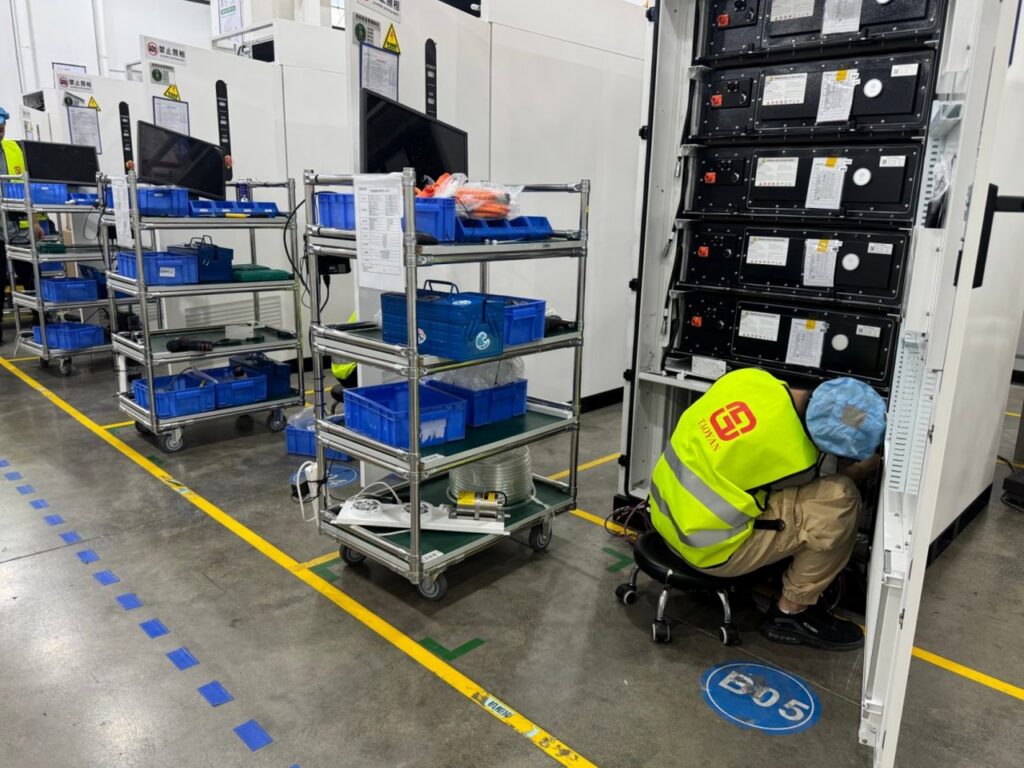
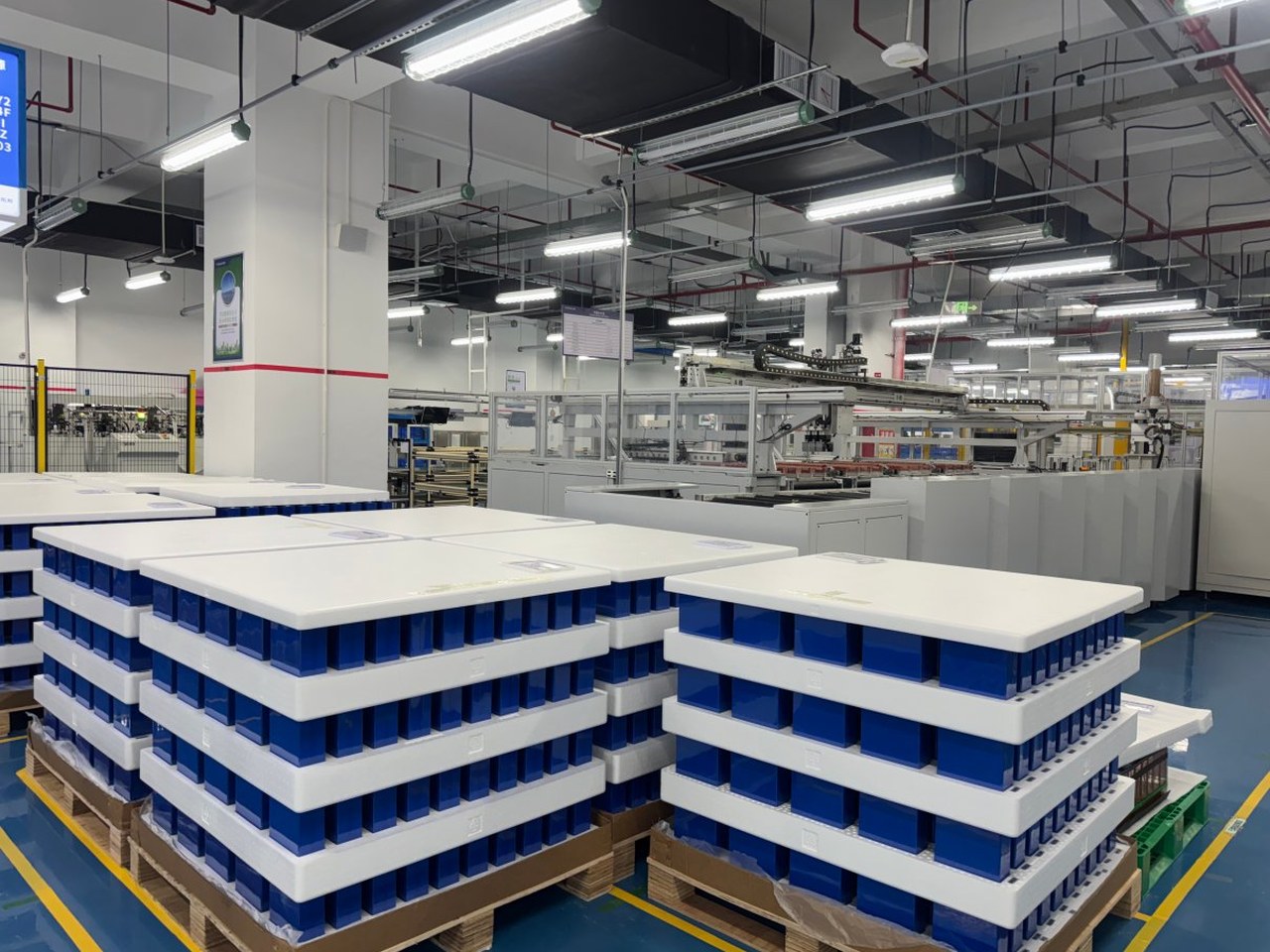
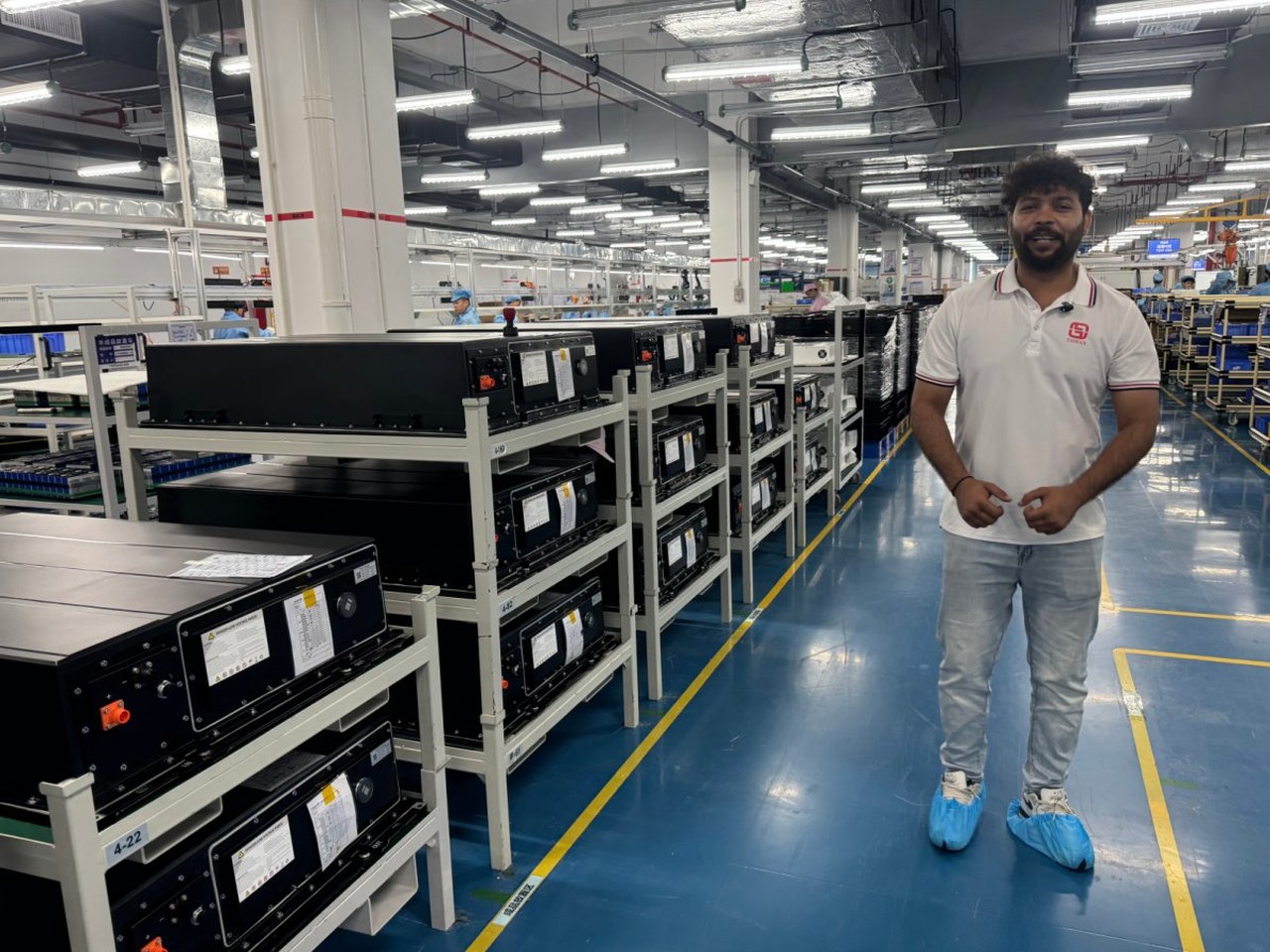
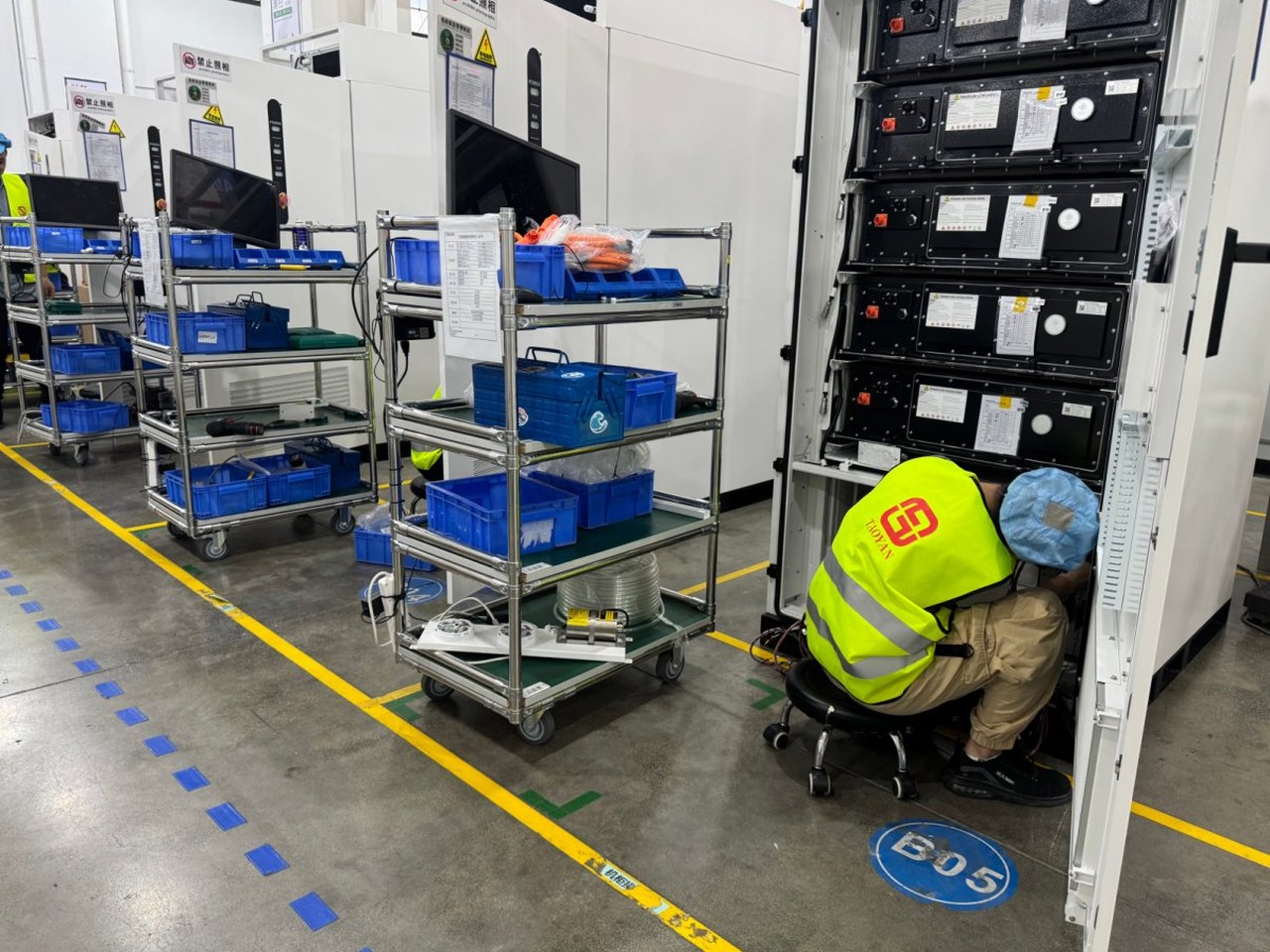
TAOYAN is a C&I energy storage system integrator based in Dongguan, China. We source 314Ah LFP cells, integrate them into cabinets and containers on our own assembly line, and develop the BMS and EMS firmware ourselves. We do not operate a cell production line, and we do not claim to. What we control is the cabinet, the thermal design, the PCS-to-BMS matching, the control firmware and the factory acceptance test — and the datasheet is the written output of that work, which is why every field in it has to be traceable to a test record or a signed technical agreement.
That is also why we publish the same specification in English, Simplified Chinese and Traditional Chinese. On a cross-border project the EPC, the owner and the site commissioning team rarely read the same language, and a parameter that changes between translations is a parameter that will be built wrong. The controlled revision of the 2610 kWh / 1250 kW grid-connected product page and its specification PDF carry the same values as the parameter table; if a downloadable file and a web page disagree, ask us for the revision number before proceeding.
We are equally direct about what an integrator cannot change: approved interconnection capacity, transformer upgrades and local tariff rules are outside our scope. Those appear at the front of every proposal as hard constraints rather than options. The specification sheet describes the equipment we can guarantee; it does not describe the grid you have been allocated.
8. The Decision in One Paragraph
Reconstruct the capacity from the cell and module configuration, separate the DC and AC voltages, contract on continuous rated power, confirm that the PV/MPPT rows match the single-line diagram, and put the physical and environmental limits into the site survey. Then require the supplier to state AC-side guaranteed energy for year one and year ten, with all four derates written out, and carry those numbers into the technical agreement. Only after that is a price-per-kWh comparison meaningful. If a datasheet cannot survive these ten checks, the problem is not the price — it is that the document does not yet describe a defined system.
Frequently Asked Questions
What does 10P260S mean on a BESS datasheet?
It describes the battery circuit: ten parallel strings, each containing 260 cells in series. With 3.2V 314Ah LFP cells, 260 in series give 832V nominal and one 1P52S module gives 166.4V / 52.25kWh; five modules in series form a 260S string of about 261.25kWh, and ten such strings in parallel reach roughly 2610kWh of DC nameplate capacity. If the stated capacity, voltage and configuration cannot be reconciled this way, ask the supplier to show the string drawing before proceeding.
Is 832V the same as the 400V grid connection voltage?
No. 832V is the nominal DC voltage of the battery string, with a 748–915V operating window across the state-of-charge range. 400V is the rated AC output of the PCS on the grid side, normally stepped up through a transformer to the site medium-voltage network. They belong to different sides of the converter and drive different equipment: the DC side sets insulation, BMS and DC protection, while the AC side sets the transformer, switchgear and cable schedule. Mixing them produces an interconnection design that cannot be built.
Why do two datasheets both saying 2610kWh lead to different prices?
Because the kWh figure may refer to different things: DC nameplate capacity of a new battery, usable energy after depth of discharge, or AC-side guaranteed output at year ten after efficiency and ageing losses. These commonly differ by twenty to thirty per cent. Ask for the basis of the figure, the year of life it applies to, and the four derates used to reach it. A price per kWh is only comparable once both quotations use the same basis.
Should the contract use rated power (1250kW) or maximum power (1300kW)?
Use rated continuous power for contractual guarantees, and record maximum power separately with its duration, ambient temperature and altitude. The maximum figure is a short-term overload capability useful for transient loads, not the output the plant sustains through a multi-hour peak. Also confirm the derating curve for high ambient temperature and high altitude, since a converter that delivers full rated power only at 25°C at sea level will not meet a summer afternoon peak at an inland site.
What does a slash mean in the PV input and MPPT rows?
On a pure grid-connected BESS it declares that the system has no PV input stage, no DC/DC charger and no MPPT controller; the battery charges from the grid through the bidirectional PCS. If those rows instead contain values such as 1000V PV input or 250–850V MPPT ranges, the document describes a hybrid machine with a different single-line diagram, EMS charge-source logic and protection zoning. A slash is a topology statement, not a blank awaiting a value.
Does IP54 mean the system can be installed outdoors without any shelter?
IP54 certifies protection against dust ingress and water splashing, not resistance to driving rain, corrosive coastal atmosphere, direct tropical sun or standing water. Outdoor placement still needs a foundation with drainage, appropriate enclosure surface treatment, sun shading where ambient temperatures are high, and clearance for service access. Ask the supplier for the site preparation drawing and the corrosion class rather than reading the IP rating as a blanket outdoor approval.
What conditions must accompany a claim of at least 8000 cycles?
Depth of discharge, operating temperature, charge and discharge C-rate, and the end-of-life capacity retention used to define a cycle’s end. A cycle count quoted at shallow discharge and 25°C is not comparable with one quoted at full depth and 45°C ambient, and neither tells you the guaranteed AC-side energy in year ten without a retention figure. Request the warranty conditions in the same document as the cycle claim, and check whether auxiliary consumption is included.
Which documents should I request besides the datasheet?
At minimum: the single-line diagram, the controlled revision number and date, the technical agreement with AC-side guaranteed output for year one and year ten, the derating curves for temperature and altitude, the site preparation and lifting drawing, the factory acceptance test procedure, and the warranty conditions behind the cycle-life claim. The datasheet is a summary; these documents are what make its numbers enforceable. Where a downloadable PDF and a web page differ, request the revision number before either is used for design.
Related Reading
More engineering notes from the TAOYAN team on the TAOYAN news page.
How to Choose a PCS for Your BESSAC voltage, continuous rating and the grid-side constraints behind the power columns
Liquid-Cooled vs Air-Cooled BESSWhy the temperature and derating rows matter more than the peak efficiency number