Views: 333 Author: taoyan-Jenny Publish Time: 2026-03-27 Origin: Site


Content Menu
● The GPT-6 Crisis: Why Traditional Backup Power is Melting
● Millisecond Mastery: BESS as a "Megawatt-scale UPS"
● Liquid Cooling Synergy: The Integrated Thermal Loop
● ROI of Reliability: Preventing the $100M "Training Crash"
● Conclusion: The New Foundation of the Silicon Age
● Frequently Asked Questions (FAQ)
● 1. How does a BESS differ from a traditional Data Center UPS?
● 2. Can the BESS help an AIDC run on 100% renewable energy?
● 3. What is "Ultra-Transient" response?
● 4. Is the liquid cooling in a BESS safe to use inside a data center?
● 5. What is the typical lifespan of a BESS in an AIDC environment?
In the hyper-competitive landscape of 2026, the global AI arms race has moved from software algorithms to the physical infrastructure that powers them. As Hyperscale Data Centers transition into Artificial Intelligence Data Centers (AIDC), they are encountering a physics crisis. The massive, oscillating power loads required by the latest H200 and B200 GPU clusters are pushing traditional electrical grids to their breaking point. For these "computing cathedrals," a micro-second voltage dip doesn't just flicker the lights—it crashes a $100 million training run, leading to weeks of data checkpoint recovery. To achieve "Six Nines" (99.9999%) reliability, the 2026 industry is turning to Ultra-Transient Battery Energy Storage Systems (BESS) as the ultimate buffer between a volatile grid and the world’s most sensitive silicon.

The workload profile of a 2026 AI model is unlike anything the power industry has seen. When a model begins a massive "inference burst" or a training "forward pass," the power demand can spike by hundreds of megawatts in less than a second.
Traditional diesel generators are too slow, taking 10-15 seconds to sync. Legacy UPS systems, designed for the steady loads of the 2010s, are struggling with the massive harmonic distortions and "step-loads" generated by AI hardware. In many global tech hubs, the grid simply cannot react fast enough, leading to localized brownouts. This is why the AIDC of 2026 requires an active, high-C-rate storage buffer that is permanently engaged—not just waiting for a failure, but constantly "smoothing" the energy flow.
In 2026, the boundary between "Energy Storage" and "Uninterrupted Power Supply (UPS)" has blurred. High-performance BESS units, utilizing Ultra-High C-rate 314Ah cells, are now functioning as the primary line of defense.
Through advanced Silicon Carbide (SiC) inverters and ultra-fast sensing, our 2026 BESS provides a seamless power switch in under 10 milliseconds. This is faster than the "hold-up time" of a standard server power supply unit (PSU).
Virtual Spinning Reserve: The BESS remains in a "hot-standby" state, providing instantaneous reactive power support to counteract the massive inrush currents of GPU racks.
Transient Load Following: As the AI workload fluctuates, the BESS injects or absorbs energy in real-time, preventing the local transformer from overheating and keeping the voltage rail perfectly flat.
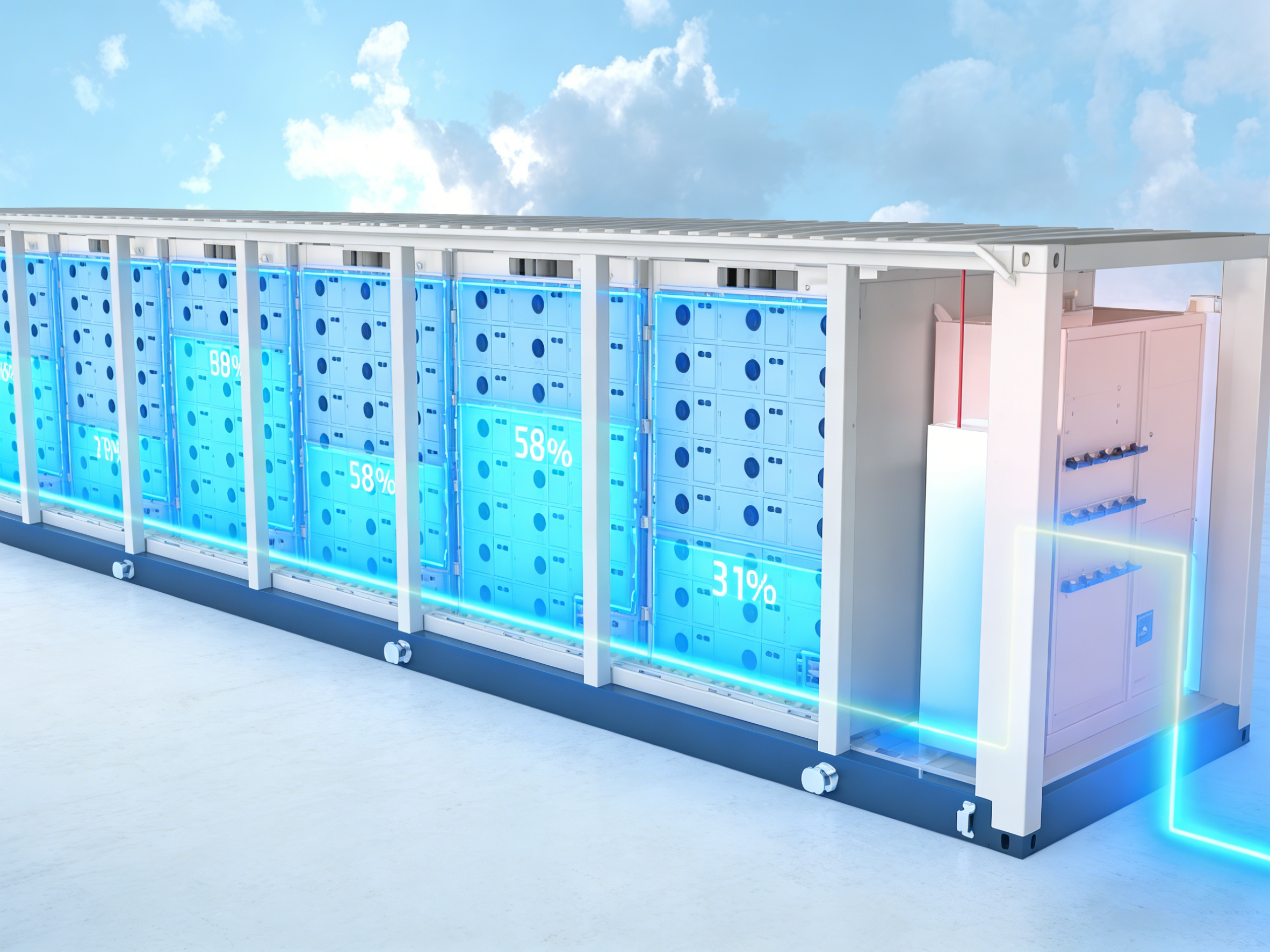
One of the most innovative breakthroughs for 2026 is the Thermal Integration between the AIDC and the BESS. Both AI servers and high-density battery racks now generate immense heat, and both have standardized on liquid cooling.
Instead of running two separate, energy-intensive cooling systems, 2026 AIDC designs are integrating them into a single, closed-loop heat exchange.
The BESS liquid cooling system maintains the batteries at a perfect 25°C ±3°C for maximum longevity.
The low-grade waste heat from the battery racks can be pre-heated for AIDC facility use, or the shared cooling towers can optimize the Power Usage Effectiveness (PUE) of the entire site. This synergy allows AIDC operators to reach the elusive PUE target of <1.1, even in tropical climates.
The financial logic for high-end BESS in 2026 is no longer about saving a few cents on the electricity bill; it is about Risk Mitigation.
The Checkpoint Penalty: Crashing a trillion-parameter model training run can result in "data corruption" at the last checkpoint. Recovering that state and re-training the lost hours can cost upwards of $2 million per incident in compute time alone.
Grid Connection Expediting: In 2026, many cities are refusing to grant new grid connections to AIDCs unless they include a massive storage buffer to "de-risk" the local substation. In this context, BESS is the "Green Pass" that allows a multi-billion dollar project to break ground.
As we look toward 2027 and the era of "Sovereign AI," the infrastructure that stores energy will be just as critical as the chips that process data. The 2026 AIDC is not just a building full of computers; it is a high-performance energy ecosystem. By integrating Ultra-Transient BESS, tech giants are ensuring that the pulse of intelligence never skips a beat. In the world of AI, energy is the fuel, but stability is the engine.
In 2026, a BESS is much larger and more versatile. While a traditional UPS only provides 5-15 minutes of backup, a GWh-scale BESS can provide hours of backup, perform grid-arbitrage to save costs, and actively stabilize the grid while "standing by."
Yes. 2026 AIDCs use BESS to "time-shift" solar and wind power, ensuring that the GPU clusters run on green energy even when the sun is down, which is essential for meeting corporate Net-Zero targets.
It refers to the ability of the Power Conversion System (PCS) to detect a voltage anomaly and inject full power into the facility in less than 10 milliseconds—preventing any interruption to the high-speed data buses.
Yes. 2026 industrial coolants are non-conductive, non-flammable, and biodegradable. The systems are designed with triple-redundant leak detection to ensure the safety of the surrounding IT equipment.
Due to the use of 314Ah high-cycle cells and AI-driven thermal management, these systems are rated for 15 to 20 years, outlasting several generations of GPU hardware.